Digitizing a family archive takes more than a high dpi number. The best high-resolution photo scanners combine accurate color, useful software, dependable handling, and a workflow that fits the size of your collection.
These 10 options cover fast batch scanning, compact flatbeds, film conversion, professional restoration, and large-format originals. Use the guide below to narrow the field by source type, resolution, speed, and budget.
Best 10 High Resolution Photo Scanners Picks for 2026
Best for High-Volume Photo Archiving

- Scans up to 36 photos per batch
- Duplex scanning captures handwritten notes
- Supports up to 1200 dpi enlargements
Best For: Large family photo collections and fast archival projects
Best Simple Photo Digitizer

- Scans 4 x 6 photos in about 2 seconds
- Supports photos up to 8 x 10 inches
- Includes one-click image enhancement
Best For: Straightforward home photo scanning
Best Premium Wireless Workflow

- Scans up to 100 photos per minute
- Includes Wi-Fi 6 and USB-C
- Automatically organizes scanned files
Best For: Fast, connected photo and document digitizing
Best for Maximum Flatbed Detail

- Offers 4800 dpi optical resolution
- Scans photos, artwork, books, and documents
- Includes one-click faded-photo restoration
Best For: Detailed individual scans and enlargements
Best Slim High-Resolution Photo Scanner

- 4800 x 4800 dpi resolution
- Fast scans and USB Type-C power/data
- Color restoration and dust removal
Best For: Space-conscious home photo and document scanning
Best Professional High-Resolution Photo Scanner
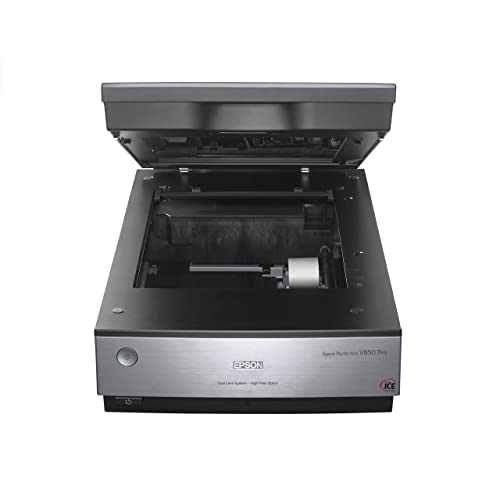
- 6400 dpi resolution
- Dual-lens optical system
- 4.0 Dmax for shadow detail
Best For: Professional photo and archival scanning
Best Large-Format High-Resolution Photo Scanner

- Handles media up to 12.2 x 17.2 inches
- Batch scanning and restoration tools
- SilverFast Ai and TWAIN included
Best For: Large photos, artwork, and archival batch scanning
High-Detail Film & Photo Pick

- 6400 dpi optical resolution
- Built-in 35mm film and slide scanning
- Digital ICE dust and scratch reduction
Best For: Digitizing detailed photos, slides, negatives, and faded prints
Compact Everyday Choice

- 4800 dpi optical resolution
- Lightweight USB-powered design
- One-click faded-photo restoration
Best For: Home photo, artwork, book, and document scanning
Advanced Film Scanning Pick

- Up to 6400 x 9600 dpi resolution
- Supports 35mm and medium-format film
- Includes Digital ICE and restoration tools
Best For: High-resolution film conversion and large photo enlargements
Best for High-Volume Photo Archiving – Epson FastFoto FF-680W
For quickly digitizing large photo collections, the Epson FastFoto FF-680W is one of the most capable high resolution photo scanners in this roundup. Its automatic feeder, duplex scanning, restoration tools, and wireless connectivity make it practical for preserving and sharing family memories.
Best For: Large batches of photos, including prints with handwritten notes on the back.
Pros:
- Scans up to 1 photo per second at 300 dpi and batch-scans up to 36 photos.
- Supports 300 dpi sharing, 600 dpi TIFF archiving, and up to 1200 dpi enlargements.
- Duplex scanning captures photos and handwritten notes in one pass.
- Includes automatic enhancement, color restoration, red-eye reduction, cropping, and de-skewing.
Cons:
- Its maximum photo size is 8 x 10 inches.
- The feature-rich design may be more scanner than casual users need.
The FF-680W is a strong choice when speed and organization matter as much as image quality. Wi-Fi, cloud backup options, OCR, and included protection for delicate photos add useful flexibility for a serious home archiving project.
Best Simple Photo Digitizer – Plustek ePhoto Z300
The Plustek ePhoto Z300 offers a straightforward way to convert common prints into digital files. As a compact high resolution photo scanner with a CCD sensor and simple front-feed design, it is focused on convenient photo digitizing rather than broad office scanning features.
Best For: Users who want an easy scanner for standard-size prints and occasional documents.
Pros:
- Scans a 4 x 6 photo in about 2 seconds at 300 dpi.
- Supports 3 x 5, 4 x 6, 5 x 7, and 8 x 10 photos, plus letter and A4 paper.
- Offers optical resolution up to 600 dpi.
- Image enhancement tools can restore faded photos with a click.
Cons:
- Photos must be inserted one at a time.
- USB connectivity and Windows 7 minimum requirements limit platform flexibility.
The Z300 is a practical alternative to a flatbed scanner for a focused photo-digitizing workflow. Its 600 dpi ceiling is lower than some flatbed models, but the quick feed process and simple enhancement tools can make transferring a large stack of everyday prints easier.
Best Premium Wireless Workflow – ScanSnap iX2500 Photo Edition
The ScanSnap iX2500 Photo Edition combines high-volume feeding with a modern wireless workflow. It is a versatile high resolution photo scanner for households or offices that need to process photos alongside documents, receipts, and business cards.
Best For: Users who want fast photo scanning, automatic organization, and wireless or USB connectivity.
Pros:
- Scans up to 100 photos per minute and holds up to 36 photos in its feeder.
- Includes three photo carrier sheets for delicate prints.
- Offers Wi-Fi 6, USB-C, cloud support, and connections to computers or mobile devices.
- Automatically optimizes, names, and sorts scanned data.
Cons:
- Its 600 dpi resolution is less suited to extreme enlargements than a 4800 dpi flatbed.
- The 7.7-pound design is less portable than compact photo scanners.
- Compatibility requires relatively current operating systems and mobile platforms.
Choose the iX2500 when scanning speed and file management are central to your workflow. Its touchscreen profiles, large feeder, carrier sheets, and cloud-ready connections make it particularly appealing for mixed photo and document collections.
Best for Maximum Flatbed Detail – Epson Perfection V19 II
The Epson Perfection V19 II is designed for users who prioritize detailed captures over batch speed. Its 4800 dpi optical resolution makes this compact flatbed a strong high resolution photo scanner for enlargements, artwork, books, and individual prints.
Best For: Detailed scans of individual photos, artwork, illustrations, and documents.
Pros:
- Provides 4800 dpi optical resolution for detailed photo scans and enlargements.
- Scans media up to 8.5 x 11.7 inches.
- Easy Photo Fix restores color to faded photos with one click.
- USB-powered, compact, and equipped with a removable high-rise lid.
Cons:
- The flatbed holds one item at a time, so large collections require more hands-on work.
- It uses USB rather than wireless connectivity.
The V19 II is the better fit when maximum stated optical resolution matters more than throughput. It is especially useful for enlarging favorite prints or scanning thicker originals that benefit from a removable high-rise lid.
Best Slim High-Resolution Photo Scanner – Canon CanoScan LiDE 400
Canon CanoScan LiDE 400 Slim Scanner, 7.7" x 14.5" x 0.4", Document & Photo Scanner, Black
Check Price On AmazonThe Canon CanoScan LiDE 400 is a compact choice for high resolution photo scanners, combining 4800 x 4800 dpi scanning with a slim design and USB Type-C data and power. Its automatic scan mode, EZ buttons, and image-enhancement tools make routine photo and document scanning straightforward.
Best For: Home users who want detailed photo scans in a space-saving flatbed scanner.
Pros:
- 4800 x 4800 dpi resolution with 48-bit color depth for detailed images.
- Color restoration and dust removal help improve older or imperfect photos.
- Scans can be completed in as fast as 8 seconds, according to the supplied notes.
- Built-in PDF buttons support multi-page, editable, and searchable PDFs.
Cons:
- Its standard sheet capacity is limited to one sheet.
- USB connectivity is required.
- Windows 7 is listed as the minimum system requirement.
Choose this model when convenience, portability, and strong photo resolution matter more than batch scanning or advanced film workflows. The included vertical stand also gives it flexible placement options.
Best Professional High-Resolution Photo Scanner – Epson Perfection V850 Pro
The Epson Perfection V850 Pro is designed for demanding photo work, using 6400 dpi resolution, a dual-lens system, and a CCD sensor to target detailed, high resolution photo scanners results. Its 4.0 Dmax rating is intended to preserve smooth tonal transitions and shadow detail.
Best For: Photographers and archival users who need professional-quality color and detail from photo scans.
Pros:
- 6400 dpi resolution supports highly detailed scans.
- Dual lenses select the appropriate optical system for different scanning needs.
- 4.0 Dmax helps capture smooth gradations and fine shadow detail.
- Supports Windows and Mac operating systems listed in the supplied notes.
Cons:
- At 20.9 pounds, it is substantially heavier than slim flatbed scanners.
- Its 19.8-inch width requires considerable desk space.
- The supplied operating-system list does not mention newer Windows versions.
This is the specialist option in the group for users prioritizing tonal quality and scanning detail over compactness. Its larger footprint and professional positioning make it better suited to a dedicated workstation.
Best Large-Format High-Resolution Photo Scanner – Epson Expression 13000XL
The Epson Expression 13000XL is a large-format option for high resolution photo scanners, accommodating reflective media up to 12.2 by 17.2 inches. Its CCD sensor, 2400 x 4800 dpi resolution, batch-scanning support, and color-restoration tools make it suited to oversized originals and productivity-focused workflows.
Best For: Studios, archives, and creative professionals scanning large photos or multiple images in batches.
Pros:
- Scans reflective media up to 12.2 by 17.2 inches.
- CCD technology, Micro Step Drive, and 3.8 Dmax support detailed, accurate scans.
- Easy Photo Fix provides one-touch color restoration and automatic dust removal.
- Included SilverFast Ai software and a TWAIN driver support advanced workflows.
Cons:
- Its 31.5-pound weight and large footprint demand substantial workspace.
- Transparency scanning requires an optional unit sold separately.
- Its 2400 dpi resolution is lower than the Epson V850 Pro’s listed 6400 dpi.
The 13000XL is the practical pick when scan size and batch productivity are more important than a compact design or maximum listed resolution. It is especially compelling for large artwork, photographs, and archival projects.
High-Detail Film & Photo Pick – Epson Perfection V550
The Epson Perfection V550 is a strong choice for shoppers seeking high resolution photo scanners with film-scanning capability. Its 6400 dpi optical resolution, built-in transparency unit, and Digital ICE technology support detailed enlargements and restoration work.
Best For: Photographers and families digitizing prints, 35mm slides, negatives, and faded photos.
Pros:
- 6400 dpi optical resolution and 48-bit color depth support vivid, detailed scans.
- Built-in transparency unit scans 35mm slides, negatives, and film.
- Digital ICE reduces the appearance of dust and scratches on film.
- Auto edge detection can scan multiple photos and save them separately.
Cons:
- USB 2.0 connectivity requires a wired computer connection.
- Its 9.6-pound body is less portable than compact models.
The V550 is especially practical when one scanner must handle both prints and film. ReadyScan LED technology avoids warm-up time, while Easy Photo Fix and OCR add useful restoration and document features.
Compact Everyday Choice – Epson Perfection V39 II
For buyers who want high resolution photo scanners in a compact format, the Epson Perfection V39 II combines 4800 dpi optical resolution with a lightweight flatbed design. It scans photos, artwork, books, and documents, while USB power helps simplify setup.
Best For: Home users who want an easy, space-saving scanner for photos and everyday documents.
Pros:
- 4800 dpi optical resolution supports clear, detailed photo scans.
- Compact 3.1-pound design fits easily in home or office workspaces.
- Easy Photo Fix restores color to faded photos with one click.
- Removable high-rise lid accommodates thicker materials such as books.
Cons:
- It is designed for photos and documents rather than film or slides.
- USB connectivity and USB power limit wireless and standalone use.
The V39 II favors convenience over specialized film features. One-touch buttons, ScanSmart tools, oversized-image stitching, and cloud-storage support make it a practical everyday option.
Advanced Film Scanning Pick – Epson Perfection V600
The Epson Perfection V600 is built for shoppers comparing high resolution photo scanners for prints and film. Its 6400 x 9600 dpi maximum resolution, CCD sensor, and built-in transparency unit support detailed enlargements from photos, 35mm media, and medium-format film.
Best For: Users digitizing mixed film formats and creating large, high-resolution photo enlargements.
Pros:
- Maximum resolution of 6400 x 9600 dpi supports enlargements up to 17 x 22 inches.
- Scans four mounted 35mm slides, 12 negatives, and medium-format film up to 6 x 22 cm.
- Digital ICE, Easy Photo Fix, and PhotoStudio support cleanup and restoration.
- ReadyScan LED technology operates without a warm-up period.
Cons:
- Its wired USB 2.0 connection does not offer wireless scanning.
- The larger flatbed format is less convenient for users with limited desk space.
The V600 is the most versatile option here for serious film conversion, particularly when medium-format support matters. Its included holders and restoration software make it a comprehensive choice for archiving and enlargement projects.
How We Picked the Best High Resolution Photo Scanners
We focused on scanners designed for photographs and other image-heavy work, then compared their optical resolution, scanning method, connectivity, software features, and handling options. Flatbed models are generally the safest choice for loose prints, delicate originals, film, and mixed sizes. Sheet-fed models can be much faster when you have boxes of standard prints and documents to process.
Resolution claims were considered alongside practical features such as color depth, dust and scratch reduction, batch capability, duplex scanning, film holders, and maximum scan size. A scanner’s real value depends on whether those features support your collection rather than simply offering the largest advertised dpi figure.
Quick Comparison
| Best For | Recommended Type | What to Prioritize |
|---|---|---|
| Large photo archives | High-speed sheet-fed scanner | Automatic feeding, batch software, and reliable handling |
| Occasional snapshots | Compact flatbed | Simple setup, accurate color, and a small footprint |
| Film and negatives | Film-capable flatbed | Dedicated holders, optical resolution, and dust correction |
| Professional restoration | Advanced photo flatbed | High-end optics, color control, and Digital ICE-style correction |
| Oversized artwork or prints | Large-format flatbed | Large scan area, rigidity, and file-management options |
Key Buying Factors for High-Resolution Photo Scanners
Optical Resolution
Look for optical resolution rather than an interpolated maximum. Around 4800 dpi is more than sufficient for most prints and enlargements, while 6400 dpi models are more useful for film, cropping, or detailed restoration. Extremely high settings also create larger files and slower scans, so they are not automatically better.
Flatbed Versus Sheet-Fed Design
A flatbed protects fragile photos and accommodates different sizes, but each original usually requires manual placement. Sheet-fed scanners are faster for uniform, loose prints and documents. Do not feed irreplaceable, curled, brittle, or heavily textured photographs unless the manufacturer explicitly supports them.
Color and Restoration Features
Good color depth, stable exposure, and accurate software profiles matter more than headline resolution alone. Dust and scratch correction can save substantial editing time when scanning film or older prints, although aggressive automatic correction may soften fine detail.
Speed, Connectivity, and File Workflow
Check whether advertised speed applies to the resolution and color mode you plan to use. USB is dependable for a desk setup, while wireless connectivity is convenient for shared households. Confirm that the included software can create TIFF files, searchable PDFs, batch names, and the correction controls you need.
Who Should Buy Which High Resolution Photo Scanners?
Choose a high-speed sheet-fed model if you are digitizing hundreds or thousands of standard prints and want the least manual handling. Choose a compact flatbed for occasional family photos, school projects, and documents where affordability and simple operation matter most.
Photographers and archivists working with negatives, slides, or enlargements should favor a film-capable flatbed with strong optical resolution and restoration tools. For professional collections, demanding color work, or oversized originals, spend more on advanced optics, a broader scan area, and better control over the capture process.
Finally, plan your storage before scanning. Capture important originals in a high-quality master format, keep organized backups, and use JPEG or PDF copies for everyday sharing. The best scanner is the one whose speed, image quality, and workflow you will use consistently.