Digitizing family photos is easier when you choose a scanner that matches the size, condition, and variety of your collection. The right model can turn boxes of prints into organized digital files without sacrificing important details.
These 10 picks cover fast batch scanning, careful flatbed work, portable photo conversion, and high-resolution restoration. Use the guide below to narrow your choice by speed, image quality, workflow, and budget.
Best 10 Photo Scanners for Family Archives Picks for 2026
Best for High-Volume Family Scanning

- Scans about one photo per second at 300 dpi
- Batch-scans up to 36 photos
- Duplex capture preserves notes on photo backs
Best For: Large family photo collections and mixed-size archives
Best Simple Photo Feeder

- Scans a 4 x 6 photo in about two seconds
- Supports prints up to 8 x 10 inches
- Includes one-click image enhancement tools
Best For: Straightforward home photo digitization
Best for Mixed Archive Organization

- Scans up to 45 pages per minute duplex
- Includes a 100-sheet document feeder
- Automatically optimizes, names, and sorts files
Best For: Mixed photo, document, receipt, and record archives
Best for Maximum Scan Detail
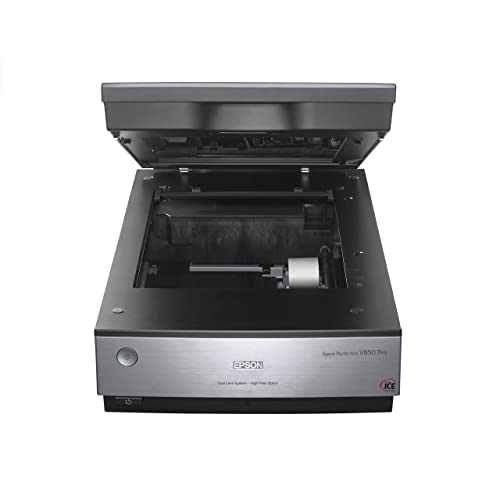
- Offers 6400 dpi scanning resolution
- Provides 4.0 Dmax tonal range
- Uses a dual-lens system and Digital ICE
Best For: Detail-focused preservation and enlargement work
Best High-Capacity Pick

- Scans up to 100 photos per minute
- Wi-Fi 6, USB-C, and cloud support
- Includes three photo carrier sheets
Best For: Large family archives and automated organization
Best Dedicated Photo Bundle

- Scans photos from 1×1 to panoramic sizes
- Includes cleaning kit and carrier sheet
- Picture Studio adds albums and editing
Best For: Mixed-size prints and careful photo handling
Best Flatbed Resolution

- Up to 4800 × 4800 dpi resolution
- Color restore and dust-removal features
- Slim USB-C flatbed design
Best For: Detailed scans of individual photos and documents
Best High-Resolution Pick

- 4800 dpi optical resolution
- Easy Photo Fix for faded photos
- Removable lid for books and thicker items
Best For: Detailed home scanning and photo restoration
Best Portable Scanner

- Lightweight 3-ounce USB design
- 15 ppm simplex scanning
- Software for cropping and cleanup
Best For: Portable mixed photo and document scanning
Best PC-Free Option
Pandigital Personal Photo Scanner

- Scans photos up to 8.5 by 11 inches
- Saves directly to an SD card
- Includes a five-in-one card reader
Best For: Standalone photo scanning without a computer
Best for High-Volume Family Scanning – Epson FastFoto FF-680W
For large family archives, the Epson FastFoto FF-680W is built to move quickly. It can batch-scan up to 36 photos, scan a photo in about one second at 300 dpi, and handle prints up to 8 x 10 inches, making it a practical choice among photo scanners for family archives.
Best For: Families digitizing thousands of mixed-size photos, postcards, Polaroids, and documents.
Pros:
- High-speed batch scanning with duplex capture for handwritten notes on photo backs
- Automatic enhancement, color restoration, red-eye reduction, cropping, rotation, and de-skew
- Wireless and USB connectivity, plus Dropbox and Google Drive backup support
- Supports 300 dpi sharing, 600 dpi TIFF archiving, and 1200 dpi enlargements
Cons:
- Its 8.2-pound size and 11.7-inch-square footprint require dedicated space
- Wireless features depend on the FastFoto app and compatible setup
The FF-680W is the strongest fit when speed and workflow efficiency matter most. Its carrier sheet and SafeTouch technology also add useful protection when feeding delicate family photos.
Best Simple Photo Feeder – Plustek ePhoto Z300
The Plustek ePhoto Z300 offers a straightforward way to digitize family prints without repeatedly lifting a scanner lid. It feeds photos one at a time and scans a 4 x 6 photo in about two seconds at 300 dpi, making it a convenient option among photo scanners for family archives.
Best For: Families wanting an easy USB photo scanner for common print sizes and occasional document scanning.
Pros:
- Scans 3 x 5, 4 x 6, 5 x 7, and 8 x 10 photos, plus letter and A4 paper
- CCD sensor provides up to 600 dpi optical resolution
- Image-enhancement tools can restore faded photos with a click
- Compact 1.5-kilogram design is lighter than many high-volume scanners
Cons:
- USB connectivity limits placement compared with wireless models
- One-photo-at-a-time feeding is less convenient for very large archives
- Supplied minimum system requirements list Windows 7 rather than current platforms
The Z300 is a sensible choice for users who prioritize simple operation over automation. Its supported print sizes and quick single-photo feeding make it more efficient than a traditional flatbed for many home projects.
Best for Mixed Archive Organization – ScanSnap iX2500
The ScanSnap iX2500 is primarily a document scanner, but its fast duplex feeder and organization tools can help households manage mixed collections of photos, receipts, documents, and family records. For photo scanners for family archives, it is most useful when photo preservation is part of a broader digitization project.
Best For: Families scanning photos alongside documents, receipts, business cards, and other paper records.
Pros:
- 45 pages-per-minute double-sided scanning with a 100-sheet feeder
- Wi-Fi 6 and USB-C connectivity support computers, mobile devices, and cloud services
- Automatic optimization, naming, and sorting can simplify archive organization
- Brake roller, multi-feed detection, and skew detection help reduce feeding problems
Cons:
- Supplied notes identify it as a business-card and document scanner rather than a dedicated photo scanner
- Its automatic feeder may be less appropriate for delicate or irregular photographic materials
- Requires relatively current operating systems and mobile platforms
The iX2500 is a workflow-oriented choice rather than a specialized photo-preservation model. Choose it when your family archive includes substantial paperwork and you value fast sorting and cloud-ready connectivity.
Best for Maximum Scan Detail – Epson Perfection V850 Pro
The Epson Perfection V850 Pro is designed for users who value image quality and fine tonal detail over scanning speed. Its 6400 dpi resolution, 4.0 Dmax, dual-lens system, and Digital ICE make it a strong specialist option among photo scanners for family archives.
Best For: Serious archivists, photographers, and families preserving important prints where maximum detail matters.
Pros:
- 6400 dpi resolution supports highly detailed scans and enlargements
- 4.0 Dmax helps preserve smooth gradations and shadow detail
- Dual-lens system selects the appropriate lens for the scan
- Digital ICE is included for image correction
Cons:
- At 20.9 pounds, it is substantially heavier than the other listed options
- USB-only connectivity limits placement and sharing flexibility
- Its supplied operating-system list is older than the requirements listed for newer models
The V850 Pro is best suited to careful, deliberate scanning rather than rapid batch work. Its high-resolution optical system makes it the most compelling option here for detail-focused preservation projects.
Best High-Capacity Pick – ScanSnap iX2500 Photo Edition
For families building photo scanners for family archives, the ScanSnap iX2500 Photo Edition combines high throughput with wireless flexibility. It can scan up to 100 photos per minute, includes three photo carrier sheets, and offers automatic file optimization and organization.
Best For: Families digitizing large photo collections and wanting automated organization, cloud support, and wireless or USB connectivity.
Pros:
- Scans up to 100 photos per minute, with an ADF holding up to 36 photos.
- Includes carrier sheets for delicate prints and supports automatic optimizations.
- Offers Wi-Fi 6, USB-C, touchscreen controls, and cloud-service support.
- Can automatically name and sort scanned files.
Cons:
- The ADF is limited to 36 photos, compared with its 100-document capacity.
- Its larger feature set may be more than needed for occasional scanning.
The iX2500 is a strong choice when speed and streamlined archive management matter most. Its 600 dpi resolution and photo carrier sheets add useful flexibility for family collections.
Best Dedicated Photo Bundle – AMBIR Photo Scanner
The AMBIR photo scanner is designed specifically for photo scanners for family archives, pairing 300 or 600 dpi scanning with a cleaning kit and protective carrier sheet. Its software also supports albums, tags, notes, and basic restoration tools.
Best For: Families scanning mixed-size prints who want photo-care accessories and built-in organization and editing tools.
Pros:
- Handles sizes from 1×1-inch photos through panoramic images up to 12 inches.
- Offers 300 and 600 dpi options for flexible image quality.
- Includes a blower, microfiber cloth, anti-static brush, and protective carrier sheet.
- Picture Studio supports albums, tags, favorites, notes, and photo editing.
Cons:
- Uses a USB connection rather than wireless connectivity.
- It is intended for photo scanning rather than general document scanning.
This bundle stands out for its focus on handling and organizing family photos. The cleaning accessories and broad size support are especially useful when an archive includes delicate, unusual, or panoramic prints.
Best Flatbed Resolution – Canon CanoScan LiDE 400
Canon CanoScan LiDE 400 Slim Scanner, 7.7" x 14.5" x 0.4", Document & Photo Scanner, Black
Check Price On AmazonFor shoppers comparing photo scanners for family archives, the Canon CanoScan LiDE 400 offers a slim flatbed design and up to 4800 × 4800 dpi resolution. Its USB-C connection handles both power and data, while image enhancements can help with color restoration and dust removal.
Best For: Families prioritizing detailed flatbed scans of individual photos, documents, and letter-size originals.
Pros:
- Provides up to 4800 × 4800 dpi resolution and 48-bit color depth.
- Scans in as fast as 8 seconds according to the supplied specifications.
- Includes color restoration, dust removal, auto scan mode, and EZ buttons.
- USB-C carries both power and data, and a vertical stand supports compact storage.
Cons:
- The flatbed holds one item at a time, so large batches may take longer.
- It connects by USB and does not offer wireless scanning.
The LiDE 400 is a practical fit for careful, high-resolution scanning when speed across a large batch is less important. Its slim profile and photo-enhancement features make it a versatile home archive scanner.
Best High-Resolution Pick – Epson Perfection V19 II
For family archives where image detail matters, the Epson Perfection V19 II is a strong choice among photo scanners for family archives. Its 4800 dpi optical resolution, flatbed design, and Easy Photo Fix technology suit photos, artwork, documents, and faded prints.
Best For: Families digitizing prints, artwork, and faded photos at home.
Pros:
- 4800 dpi optical resolution for detailed scans and enlargements.
- Easy Photo Fix can restore color to faded photos with one click.
- Removable high-rise lid accommodates books and thicker materials.
- USB-powered design and one-touch buttons simplify home scanning.
Cons:
- Flatbed scanning requires placing items individually.
- Designed for a maximum scan area of 8.5 by 11.7 inches.
- USB connection is required.
The V19 II is the most detail-focused option here and adds useful restoration assistance for aging family photos. It is particularly practical when scan quality matters more than batch speed.
Best Portable Scanner – HPPS100 Mobile Photo Scanner
If you need to scan family photos alongside receipts and documents, the HPPS100 offers a compact sheetfed approach. Among photo scanners for family archives, it stands out for USB portability, 15-page-per-minute simplex scanning, and software tools for cropping and image cleanup.
Best For: Portable archive projects involving photos, papers, receipts, and business cards.
Pros:
- Compact 3-ounce design fits easily in a bag or briefcase.
- 15 ppm one-sided scanning supports small- to medium-size batches.
- 1200 dpi resolution handles photos and general documents.
- HP WorkScan supports previewing, cropping, editing, and background cleanup.
Cons:
- Sheetfed design scans one side at a time.
- Requires a Windows or Mac computer and USB connection.
- Its maximum listed paper size is 8.5 by 14 inches.
The HPPS100 is a convenient choice when portability and mixed-media scanning are priorities. Its software is useful for organizing and cleaning up scans, though a flatbed may be preferable for delicate or unusually shaped photos.
Best PC-Free Option – Pandigital Personal Photo Scanner
The Pandigital PANSCN06 is a straightforward option for family archives when you want to scan photos without a computer. It scans photos up to 8.5 by 11 inches at 600 dpi and saves directly to an SD card for later transfer.
Best For: Simple photo digitization with direct SD-card storage.
Pros:
- Scans photos up to 8.5 by 11 inches.
- Direct-to-SD-card scanning works without a PC.
- Built-in five-in-one reader supports SD, MS, MSPRO, MMC, and XD cards.
- Scans can be transferred to a digital photo frame or computer.
Cons:
- 600 dpi resolution is lower than the Epson and HP options.
- Designed specifically for photos rather than broader document scanning.
- Requires an SD card for its computer-free workflow.
The Pandigital is appealing for uncomplicated, standalone scanning and easy memory-card transfer. Its lower resolution makes it better suited to convenient everyday archiving than to large, highly detailed enlargements.
How We Picked the Best Photo Scanners for Family Archives
We focused on the features that matter most when converting years of family memories: photo-handling speed, scan quality, ease of use, connectivity, and flexibility. The selection includes sheet-fed models for large batches, flatbed scanners for delicate or unusual originals, and compact options for occasional projects.
We also considered whether a scanner supports automatic feeding, duplex scanning, dust and scratch correction, multiple resolutions, and useful software. A fast scanner is not automatically the best choice if it cannot safely handle older prints, while a high-resolution model may be unnecessary for casual sharing.
Quick Comparison
| Best For | Look For | Best-Fit Models |
|---|---|---|
| Large photo collections | Automatic feeding and batch processing | Epson FastFoto FF-680W, Plustek ePhoto Z300 |
| Maximum image quality | High optical resolution and flatbed scanning | Epson Perfection V850 Pro, Epson Perfection V19 II |
| Documents and photos | Fast wireless or USB multipurpose scanning | ScanSnap iX2500 models, Canon LiDE 400 |
| Portable or occasional use | Compact design and simple operation | AMBIR Photo Scanner, HPPS100, Pandigital PANSCN06 |
Key Buying Factors for Photo Scanners for Family Archives
Speed and Feeding Capacity
If you have hundreds or thousands of prints, prioritize an automatic sheet-fed scanner with batch workflows. Flatbeds are slower because each item usually requires individual placement, but they are better for fragile, thick, curled, or oddly sized originals.
Resolution and Image Quality
For ordinary prints, 300 to 600 dpi is generally sufficient for sharing and standard reprints. Choose a higher-resolution flatbed when you plan to enlarge images, preserve fine detail, or scan negatives and slides. Optical resolution matters more than an inflated interpolated number.
Photo Safety and Restoration Tools
Older photographs may be brittle, dusty, or lightly scratched. Look for gentle handling, a flat scanning surface, and software features such as dust removal, color correction, or scratch reduction. Test valuable originals before committing to a large batch.
Connectivity and Software
Wireless scanning can simplify household use, while USB is often dependable and straightforward. Check operating-system compatibility, file-format options, automatic cropping, multi-image detection, and whether the included software supports your preferred backup workflow.
Who Should Buy Which Photo Scanners for Family Archives?
Choose a high-speed sheet-fed model if your priority is digitizing a large box of standard-size prints quickly. The Epson FastFoto FF-680W and Plustek ePhoto Z300 are natural starting points for batch-oriented projects.
Choose a flatbed scanner if image fidelity, delicate originals, or flexible sizing matters more than speed. The Epson Perfection V850 Pro is aimed at demanding archival work, while the V19 II and Canon LiDE 400 suit more routine home scanning.
Choose a multipurpose wireless scanner if you also need to process receipts, paperwork, and documents. The ScanSnap iX2500 options are designed for broader home-office workflows.
Choose a compact or portable option for occasional scanning, travel, or limited storage space. Before buying, verify the supported photo sizes and computer requirements so the scanner fits your archive rather than creating extra manual work.