Professional photo scanning demands more than high resolution. The right scanner must match your originals, workflow, color-management needs, and daily volume without sacrificing detail or reliability.
We selected 10 standout models for digitizing prints, negatives, slides, documents, and oversized artwork, from fast batch scanners to precision flatbeds built for archival and creative work.
Best 10 Photo Scanners for Professionals Picks for 2026
Best High-Volume Photo Scanner

- Batch-scans up to 36 photos
- Duplex capture preserves notes
- Wireless, OCR, and image correction
Best For: Large photo collections and mixed photo-document workflows
Best Compact Photo Feeder

- Scans 4x6 photos in about two seconds
- Supports photos up to 8x10
- CCD sensor with image restoration
Best For: Standard-size prints and simple USB workflows
Best Large-Format Detail

- Scans media up to 12.2 x 17.2 inches
- 2400 x 4800 dpi and 48-bit color
- Includes SilverFast Ai and IT8 targets
Best For: Graphic-arts studios and large reflective originals
Best Connected Workflow

- Scans up to 100 photos per minute
- Wi-Fi 6 and USB-C connectivity
- Automatic naming and sorting
Best For: Mixed photo-document workflows with cloud and device sharing
Large-Format Workhorse
Expression 11000XL Graphic Arts Scanner

- Scans originals up to 12.2 x 17.2 inches
- 2400 x 4800 dpi with MatrixCCD sensor
- Designed for professional flatbed workflows
Best For: Large artwork, photos, and graphic-arts originals
High-Detail Film Specialist

- 6400 dpi resolution for detailed scans
- Dual-lens system for optimized results
- Supports photos and slides with 4.0 Dmax
Best For: Detailed photo and slide digitization
Modern Large-Format Pro
Expression 13000XL Photo Scanner

- Scans reflective media up to 12.2 x 17.2 inches
- Batch scanning and Easy Photo Fix support productivity
- Includes SilverFast Ai and TWAIN software
Best For: Batch scanning of oversized photos and artwork
Professional Detail Leader
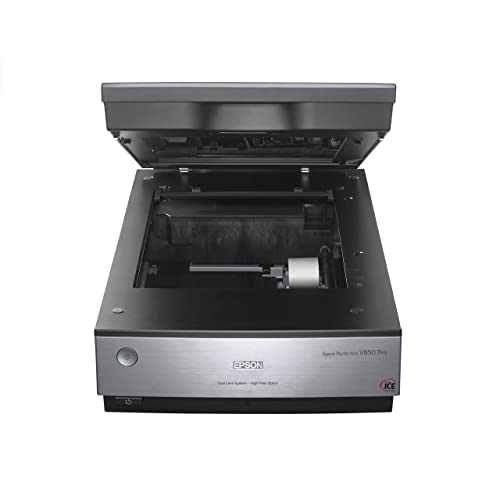
- 6400 dpi resolution and 4.0 Dmax
- Dual-lens system for optimized scanning
- CCD sensor with Digital ICE support
Best For: Professional photo and film digitization
Restoration-Focused Value
Epson Perfection V500 Photo Scanner

- Scans prints, slides, negatives, and medium-format film
- Digital ICE removes dust and scratches
- Easy Photo Fix restores faded photos
Best For: Mixed photo and film scanning with basic restoration
Flexible Film Workflow
Epson Perfection V600 Photo Scanner

- Handles prints, documents, slides, and film
- Built-in transparency unit with film holders
- Up to 6400 x 9600 dpi and 17 x 22-inch enlargements
Best For: Versatile print, slide, negative, and medium-format scanning
Best High-Volume Photo Scanner – Epson FastFoto FF-680W
For professionals looking for photo scanners for professionals that can process large collections efficiently, the Epson FastFoto FF-680W combines batch feeding, duplex capture, wireless connectivity, and automatic image corrections. It can scan up to 36 photos in one batch and reach speeds of up to one photo per second at 300 dpi.
Best For: High-volume photo digitization projects that also require document scanning and flexible file options.
Pros:
- Batch-scans up to 36 photos and reaches up to 45 ppm/90 ipm for documents.
- Captures photos and handwritten notes on the reverse side in one pass.
- Supports 300 dpi sharing, 600 dpi TIFF archiving, and 1200 dpi enlargements.
- Includes auto enhancement, color restoration, red-eye reduction, cropping, rotation, and OCR.
Cons:
- Its automatic feeder is less suited to unusually fragile originals than careful flatbed handling.
- Windows 7 or later is listed as the minimum system requirement.
The FF-680W is a strong all-around choice when throughput matters. Wireless and USB connections, cloud backup support, and a supplied carrier sheet make it practical for organized preservation workflows.
Best Compact Photo Feeder – Plustek ePhoto Z300
The Plustek ePhoto Z300 is a straightforward option among photo scanners for professionals who want faster handling than a traditional flatbed without needing wireless features. Its CCD sensor scans 4×6 photos in about two seconds at 300 dpi and supports several common photo and paper sizes.
Best For: Efficient desktop scanning of standard-size prints when simple USB operation is sufficient.
Pros:
- Scans a 4×6 photo in about two seconds and an 8×10 photo in about five seconds at 300 dpi.
- Supports 3×5, 4×6, 5×7, 8×10, letter, and A4 media.
- Offers 300 dpi and 600 dpi settings with one-click image enhancement and restoration.
Cons:
- USB is the only listed connection type.
- Its standard sheet capacity is one, so photos must be inserted individually.
- Windows 7 is the listed minimum system requirement.
The Z300 prioritizes ease of use and a small desktop footprint over automation. It is a sensible fit for professionals digitizing common print sizes in a controlled, one-at-a-time workflow.
Best Large-Format Detail – Epson Expression 12000XL-GA
For demanding photo scanners for professionals workflows, the Epson Expression 12000XL-GA uses a large flatbed, 2400 x 4800 dpi resolution, 48-bit color depth, and a 3.8 Dmax rating to capture detailed reflective originals. Its generous scanning area accommodates media up to 12.2 by 17.2 inches.
Best For: Studios and graphic-arts workflows that need high-detail scans from large prints and multiple images.
Pros:
- Accommodates reflective media up to 12.2 by 17.2 inches.
- Combines 2400 x 4800 dpi resolution, 48-bit color, and a 3.8 Dmax rating.
- Supports batch scanning of multiple printed images.
- Includes color restoration, automatic dust removal, SilverFast Ai, and two IT8 targets.
Cons:
- At 31.5 pounds, it is substantially less portable than compact photo scanners.
- Its listed connection is USB rather than wireless.
- The 18-by-25.8-inch footprint requires considerable workspace.
The 12000XL-GA is built for image quality and oversized originals rather than casual portability. It makes the most sense where color accuracy, detail, and flatbed flexibility justify its larger size.
Best Connected Workflow – ScanSnap iX2500 Photo Edition
The ScanSnap iX2500 Photo Edition suits professionals seeking photo scanners for professionals with modern connectivity and streamlined organization. It combines a 100-photo-per-minute scanning rate, a feeder for up to 36 photos, a large touchscreen, Wi-Fi 6, USB-C, and automatic file naming and sorting.
Best For: Connected teams and professionals who scan photos alongside documents, receipts, and business cards.
Pros:
- Scans up to 100 photos per minute and holds up to 36 photos or 100 documents.
- Provides Wi-Fi 6, USB-C, cloud-service support, and device connectivity.
- Automatically optimizes, names, and sorts scanned data.
- Includes three photo carrier sheets for delicate prints and customizable touchscreen profiles.
Cons:
- The listed operating-system requirements are relatively current, including Windows 10/11 and macOS Monterey or later.
- Its automatic feeder workflow may be less appropriate for originals requiring individual flatbed placement.
The iX2500 stands out for speed, organization, and device flexibility. It is particularly compelling when a photo archive is part of a broader document-management workflow rather than a standalone preservation project.
Large-Format Workhorse – Expression 11000XL Graphic Arts Scanner
Epson Expression 11000XL Graphic Arts Scanner, Scan Up to 12.2 x 17.2, 2400 dpi Optical Resolution
Check Price On AmazonFor professionals who need to digitize artwork, photographs, and other oversized originals, the Epson Expression 11000XL is a substantial flatbed option. Its 12.2 x 17.2-inch scan area, CCD sensor, and 2400 x 4800 dpi capability make it well suited to large-format photo scanning workflows.
Best For: Professionals scanning large reflective originals and graphic-arts materials.
Pros:
- Accommodates originals up to 12.2 x 17.2 inches.
- Uses an Epson MatrixCCD sensor and Micro Step Drive technology.
- Supports 2400 x 4800 dpi scanning and 48-bit color depth.
Cons:
- Its 14,500-gram weight makes it a substantial desktop unit.
- Uses a USB connection rather than a wireless interface.
- Listed operating-system support is limited to older Windows and Mac OS X versions.
The 11000XL prioritizes scan size and professional flatbed capability over portability. It is a practical choice when oversized originals are central to your workflow and desk space is available.
High-Detail Film Specialist – Epson Perfection V800 Photo
The Epson Perfection V800 Photo is a strong fit for photo scanners for professionals who need fine detail across prints and film. It combines 6400 dpi resolution, a dual-lens system, 4.0 Dmax, and support for photo and slide media.
Best For: Professionals scanning photographs, slides, and other film-based media.
Pros:
- Provides 6400 dpi resolution for detailed scans.
- Dual Lens System selects between lenses for different scanning needs.
- Offers 4.0 Dmax and 16-bit grayscale depth for smooth tonal detail.
- Supports both photo and slide media.
Cons:
- Has a one-sheet standard capacity.
- Weighs 20.9 pounds, so it is not especially portable.
- Listed operating-system support covers older Windows and Mac OS X versions.
With its film support, high resolution, and tonal-range specifications, the V800 is oriented toward quality-focused photo digitization. Choose it when slides and detailed originals matter more than high-volume sheet throughput.
Modern Large-Format Pro – Expression 13000XL Photo Scanner
The Epson Expression 13000XL is built for professional large-format photo scanning, with room for originals up to 12.2 x 17.2 inches and batch-scanning support. Its 2400 x 4800 dpi resolution, MatrixCCD sensor, and included SilverFast Ai software support detailed, repeatable workflows.
Best For: Studios and professionals scanning oversized photos or artwork in batches.
Pros:
- Accommodates reflective media up to 12.2 x 17.2 inches.
- Supports batch scanning for increased productivity.
- Includes Easy Photo Fix for color restoration and automatic dust removal.
- Includes SilverFast Ai with calibration targets and a TWAIN driver.
Cons:
- Film scanning requires the optional Transparency Unit, sold separately.
- Its 25.8-inch width and 31.5-pound weight require dedicated workspace.
- Uses a USB connection.
The 13000XL is the most workflow-oriented option here, adding batch scanning, restoration tools, and included professional software to its large-format design. It is especially compelling for users processing many oversized originals rather than occasional snapshots.
Professional Detail Leader – Epson Perfection V850 Pro
For professionals who need high-quality photo scanners for professionals, the Epson Perfection V850 Pro combines a listed 6400 dpi resolution, 4.0 Dmax tonal range, and a dual-lens system designed to optimize scans across different originals. Its CCD sensor and Digital ICE support detailed, carefully restored results.
Best For: Professional photo, film, and archival scanning where fine detail and smooth shadow gradation matter.
Pros:
- 6400 dpi resolution for detailed scans and enlargements.
- 4.0 Dmax supports smooth tonal transitions and shadow detail.
- Dual-lens system selects between lenses for optimized results.
- Digital ICE helps with image cleanup.
Cons:
- At 20.9 pounds, it is relatively heavy for a flatbed scanner.
- Its professional capabilities may be more than casual users need.
- USB connectivity requires a direct computer connection.
The V850 Pro is the strongest fit here for demanding workflows that prioritize tonal range, resolution, and scanning control over portability or simplicity.
Restoration-Focused Value – Epson Perfection V500 Photo Scanner
The Epson Perfection V500 is a practical choice among photo scanners for professionals who need to digitize prints, slides, negatives, and medium-format film without giving up restoration tools. Its 6400 dpi resolution, Digital ICE, and Easy Photo Fix cover common cleanup and enlargement tasks.
Best For: Home studios, archives, and small professional projects involving mixed photo and film originals.
Pros:
- Scans photos, slides, negatives, and medium-format film.
- 6400 dpi resolution supports clear photo enlargements.
- Digital ICE removes dust and scratches from images.
- Easy Photo Fix restores faded photos with one touch.
Cons:
- The supplied notes list Windows 7 as the minimum system requirement.
- It has fewer stated professional-oriented specifications than the V850 Pro.
- USB connectivity limits it to a wired computer setup.
The V500 balances film compatibility and restoration features, making it a sensible option when the workflow includes varied originals and straightforward image correction.
Flexible Film Workflow – Epson Perfection V600 Photo Scanner
The Epson Perfection V600 is one of the more versatile photo scanners for professionals handling both prints and film. It supports 35mm slides, negatives, medium-format film, and documents, while its 6400 x 9600 dpi maximum resolution and built-in transparency unit support large enlargements.
Best For: Photographers and small archives that need one flatbed scanner for prints, documents, slides, negatives, and medium-format film.
Pros:
- Scans 35mm, medium-format film, photos, and documents.
- Built-in transparency unit holds four mounted slides or 12 negatives.
- 6400 x 9600 dpi maximum resolution supports enlargements up to 17 x 22 inches.
- Digital ICE, Easy Photo Fix, and included PhotoStudio software add restoration options.
Cons:
- Hi-Speed USB 2.0 is the listed connectivity option.
- The supplied notes list Windows 7 as the minimum system requirement.
- Its flatbed design may be slower for very high-volume batch work.
The V600 stands out for format flexibility: its film holders, transparency unit, restoration tools, and document support make it a capable all-around scanning station.
How We Picked the Best Photo Scanners for Professionals
We compared these Photo Scanners for Professionals by looking at optical resolution, scan quality, color accuracy, original-size support, film capabilities, throughput, connectivity, software, and long-term workflow practicality. We also considered whether each model is best suited to batch digitization, restoration, graphic arts, archival work, or mixed office and studio use.
Advertised resolution is only one part of performance. A scanner with strong optics, dependable color handling, dust and scratch correction, and useful software can produce better working files than a higher-rated model with a less suitable design.
Quick Comparison
| Best For | Scanner Type | Key Strength |
|---|---|---|
| Large photo libraries | Sheet-fed | Fast batch scanning and duplex document handling |
| Simple 4×6 scanning | Dedicated photo feeder | Quick, straightforward operation |
| Film and prints | Flatbed | Flexible originals and high-detail scans |
| Professional artwork | Large-format flatbed | Oversized originals and precision imaging |
| Mixed office workflows | Wireless or USB feeder | Convenient network and document scanning |
Key Buying Factors for Photo Scanners for Professionals
Original Size and Scanner Design
Choose a sheet-fed model for large batches of loose prints and documents. Flatbeds are better for fragile, thick, curled, or valuable originals, as well as artwork that cannot pass through rollers. Large-format scanners are essential when your work includes oversize photographs, contact sheets, maps, or artwork.
Resolution and Image Quality
For standard prints, a true optical resolution around 600 dpi is often enough for high-quality reproductions. Higher optical resolutions matter more for film, small originals, cropping, and substantial enlargements. Prioritize optical performance and tonal detail over interpolated resolution claims.
Film Support and Restoration Tools
If you scan negatives or slides, verify the included holders, supported film sizes, and infrared-based dust and scratch correction. These features can reduce retouching time, but they do not replace careful cleaning and color correction.
Speed, Connectivity, and Software
Estimate your weekly volume before choosing. Automatic feeders save time for large collections, while flatbeds favor control and quality. Wireless connectivity can simplify shared workflows, but USB is often the most predictable option for demanding studio systems. Check compatibility with your operating system and preferred editing or archival software.
Who Should Buy Which Photo Scanners for Professionals?
- Choose a high-speed photo feeder if you are digitizing hundreds or thousands of loose prints and want minimal manual handling.
- Choose a compact dedicated photo scanner if your priority is quick 4×6 scanning with a simple learning curve.
- Choose a film-capable flatbed if you need one scanner for prints, negatives, slides, and occasional enlargements.
- Choose a professional large-format flatbed for artwork, oversized originals, color-critical production, or archival projects.
- Choose a wireless document-oriented scanner if photo scanning is part of a broader office digitization workflow.
Before buying, confirm desk space, operating-system support, replacement accessories, and the file formats your archive requires. The best model is the one that fits your originals and daily process, not simply the one with the highest headline resolution.