Wireless video transmitters make it easier to send camera or computer footage to monitors, recorders, streamers, and multiple viewing devices without running long cables. The right system depends on more than advertised range: resolution, latency, connectivity, interference resistance, and receiver support all affect real-world performance.
We compare 10 video transmitters spanning compact HDMI kits, professional SDI/HDMI systems, multi-receiver setups, and UVC-ready options for livestreaming. Use the guide below to narrow your choice by workflow, budget, and required reliability.
Best 10 Video Transmitters Picks for 2026
Professional 4K Monitoring

- 4K30 HDMI transmission with 60ms latency
- Up to 1,300ft range and four receivers
- UVC streaming, loopout, and smart channel scan
Best For: Film sets, live production, and multi-viewer monitoring
Multi-Screen Convenience
Wireless HDMI Quad Receiver Kit

- One transmitter supports four simultaneous receivers
- 165ft open-environment transmission range
- Includes adapters for several HDMI source types
Best For: Presentations, classrooms, and multi-display setups
Long-Range SDR Production

- Up to 3km range with anti-interference frequency hopping
- 1080p60, 20Mbps bitrate, and 35ms latency
- SDI, HDMI, USB-C, and unlimited Broadcast mode receivers
Best For: Professional crews and complex-location monitoring
Extended 1080p HDMI Links
Vrriis WL081 Wireless HDMI Extender

- 1080p60 transmission with claimed 0.05s latency
- Up to 1,300ft open-field range
- Loopout and IR remote-control support
Best For: Home entertainment, offices, churches, and conferences
Professional Streaming Pick

- Dual-band 1080p60 transmission with up to 1,200ft range
- UVC and RTMP support for direct livestreaming workflows
- One transmitter can feed up to four monitoring devices
Best For: Filmmaking, live events, and multi-device production monitoring
Long-Range Home and Event Pick

- 1080p60 wireless HDMI with up to 820ft open-field range
- HDMI loop-out and IR remote-control support
- Can expand from one transmitter to up to four receivers
Best For: Home theaters, presentations, churches, and conference rooms
Compact Creator Pick

- 1080p60 transmission with 50ms latency and up to 656ft range
- HDMI loop-out enables simultaneous local and wireless monitoring
- Runs on NP-F batteries or USB-C power
Best For: Camera operators, presenters, and portable monitoring setups
Best for Osmo Pocket 3 Streaming

- Built-in Type-C transmitter for Osmo Pocket 3
- UVC output for up to 1080p@60Hz PC streaming
- 1-to-5 receiver support with HDMI loop-out
Best For: Osmo Pocket 3 live streaming and portable multi-screen monitoring
Best All-in-One Monitoring Kit
7-Inch Wireless HDMI Monitor System
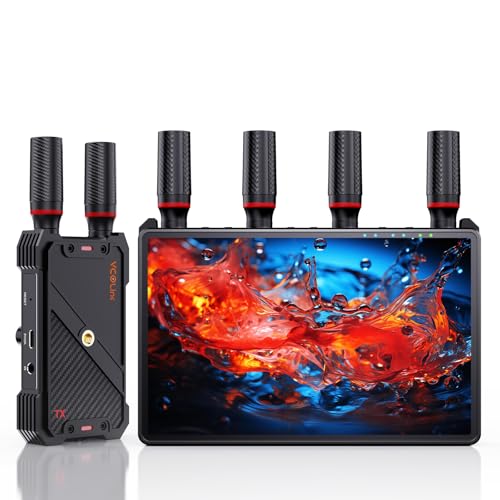
- Receiver includes a built-in 7-inch HD screen
- 1080p@60Hz transmission with claimed sub-0.05-second latency
- Supports up to five receivers and HDMI loop-out
Best For: On-set monitoring and collaborative video production
Best for 4K Professional Workflows
Hollyland Mars 4K Wireless Link

- 4K HDMI transmission up to 30fps
- HDMI and 3G-SDI input/output options
- App monitoring for up to four mobile devices
Best For: Professional camera crews using 4K HDMI and SDI equipment
Professional 4K Monitoring – Hollyland Pyro H
For filmmakers and live-production teams comparing video transmitters, the Hollyland Pyro H stands out with 4K30 HDMI transmission, dual-band connectivity, smart channel scanning, and a claimed range of up to 1,300 feet. Its UVC support also makes computer-based live streaming straightforward.
Best For: Film sets, live broadcasts, ENG/EFP work, and multi-person monitoring.
Pros:
- Supports video up to 3840×2160 at 24/25/30fps over HDMI.
- Up to 1,300 feet of range with 60ms latency in the supplied specifications.
- Can connect with up to four receivers for shared monitoring.
- Includes HDMI input, output, loopout, and UVC live-streaming support.
Cons:
- The listed 4K transmission rate tops out at 30fps.
- Its professional feature set may be more than needed for basic home viewing.
- Performance can depend on the wireless environment and channel conditions.
The Pyro H is a strong choice when reliable crew monitoring and flexible connectivity matter more than a minimalist setup. Smart channel scanning and app support add useful control for demanding shoots.
Multi-Screen Convenience – Wireless HDMI Quad Receiver Kit
This wireless HDMI kit is designed for sending one source to several displays without running long cables. With four receivers, dual-band operation, plug-and-play setup, and supplied HDMI adapters, it suits presentations, classrooms, conference rooms, and home entertainment systems.
Best For: Multi-screen presentations, classrooms, conference rooms, and casual home viewing.
Pros:
- Four receivers can work simultaneously with one transmitter.
- Supports transmission up to 165 feet in an open environment.
- Includes USB-C-to-HDMI, Micro HDMI, and Mini HDMI adapters.
- Supports Windows and Mac multi-screen extension modes.
Cons:
- The stated range is substantially shorter than some dedicated production video transmitters.
- Each unit requires separate USB power from a 5V/1A-or-higher charger.
- Actual coverage may vary with walls, interference, and the surrounding environment.
For buyers who need several displays fed from one source, the four-receiver bundle offers practical flexibility at setup. It is better suited to general AV distribution than to demanding long-range production work.
Long-Range SDR Production – DJI SDR Transmission Combo
The DJI SDR Transmission Combo is built for professional video monitoring where range, interference resistance, and stable control are priorities. It supports 1080p60 video at up to 20 Mbps, offers multiple monitoring methods, and can use Broadcast mode for an unlimited number of receivers.
Best For: Professional shoots, complex locations, live-feed monitoring, and DJI Ronin workflows.
Pros:
- Up to 3 km or 10,000 feet of transmission distance according to the supplied specifications.
- Automatic frequency hopping across 2.4 GHz, 5.8 GHz, and DFS bands helps address interference.
- Supports 1080p60 video with claimed 35ms latency and up to 20 Mbps bitrate.
- Provides SDI, HDMI, USB-C monitoring, and Ronin-related control features.
Cons:
- Video transmission is specified at 1080p rather than 4K.
- Its professional capabilities may be excessive for simple point-to-point home use.
- The supplied listing does not specify a compact plug-and-play workflow for every camera setup.
Among these video transmitters, the DJI system is the most production-focused option for long-distance monitoring and difficult RF environments. Its SDR design and Broadcast mode are especially useful when several people need access to a live feed.
Extended 1080p HDMI Links – Vrriis WL081 Wireless HDMI Extender
The Vrriis WL081 is a straightforward option for extending an HDMI source to a distant TV or projector. It combines 1080p60 support, loopout, IR remote control, dual-band wireless transmission, and a claimed open-field range of up to 1,300 feet.
Best For: Home entertainment, offices, churches, conferences, and sports or gaming displays.
Pros:
- Supports Full HD 1080p at 60Hz with claimed 0.05-second latency.
- Includes transmitter-side loopout for adding a local monitor.
- IR support allows remote control of the HDMI source from the viewing location.
- Works with TVs, projectors, laptops, set-top boxes, and other HDMI sources.
Cons:
- It does not offer 4K transmission based on the supplied specifications.
- The 1,300-foot range is stated for an open field and can fall with walls or other obstacles.
- Adding receivers can reduce the available transmission distance.
The WL081 makes sense when you want a simple wireless HDMI connection with useful local monitoring and IR control. It is a practical 1080p extender, but buyers should treat the maximum range as an ideal-condition figure.
Professional Streaming Pick – Accsoon CineView HE
For demanding filmmaking and live-production workflows, the Accsoon CineView HE is one of the most capable video transmitters in this group. Its dual-band 2.4GHz and 5GHz transmission supports 1080p video at 60fps, while UVC connectivity enables plug-and-play computer streaming without a separate capture card.
Best For: Filmmakers, live-event crews, and creators who need long range, multi-device monitoring, and direct computer or RTMP streaming.
Pros:
- Up to 1,200 feet of range and less than 0.06 seconds of latency in suitable conditions.
- Dual-band transmission is designed to improve stability in crowded wireless environments.
- Supports one transmitter to up to four receivers, including mixed iOS and Android monitoring.
- HDMI loop-out provides zero-latency local monitoring, and UVC supports computer livestreaming.
Cons:
- Batteries and charging cables are not included.
- Its professional feature set may be more than needed for basic home entertainment.
The CineView HE stands out when range, crew monitoring, and streaming flexibility matter most. Its multiple power options and broad workflow compatibility add convenience, but buyers should budget separately for compatible batteries or cables.
Long-Range Home and Event Pick – Vrriis Wireless HDMI Extender
The Vrriis wireless HDMI kit is a practical choice for extending 1080p video from a laptop, set-top box, game console, or camera to a distant TV or projector. These video transmitters use 2.4GHz and 5.8GHz wireless bands, include loop-out monitoring, and offer a straightforward plug-and-play setup.
Best For: Home theaters, offices, churches, conference rooms, and presentations requiring wireless HDMI over a long open-field distance.
Pros:
- Supports up to 1080p at 60Hz with approximately 0.06 seconds of latency.
- Rated for transmission up to 820 feet in an unobstructed, low-interference open field.
- HDMI loop-out allows a local display, while IR support enables remote source control.
- One transmitter can support up to four receivers, with additional receivers sold separately.
Cons:
- Walls, glass, and other obstacles can significantly reduce signal range.
- Transmission distance decreases as more receivers are added.
- The kit is limited to Full HD rather than higher-resolution formats.
This Vrriis system offers useful flexibility for everyday HDMI distribution, especially when a local monitor and IR control are helpful. Its advertised range is most realistic in open conditions, so indoor layouts should be evaluated carefully.
Compact Creator Pick – Lemorele R5000 Wireless HDMI
The Lemorele R5000 is a compact option for creators who want simple wireless camera monitoring without complicated network setup. This 5GHz video transmitter and receiver system sends 1080p video at 60Hz, includes an HDMI loop-out port, and supports preview through the TUTUPlay mobile app.
Best For: DSLR and camcorder users, mobile production teams, classroom presenters, and home-theater setups needing portable Full HD transmission.
Pros:
- Provides 1080p at 60Hz with 50ms latency for responsive monitoring.
- Offers up to 656 feet of range in open, unobstructed conditions.
- HDMI loop-out supports simultaneous local viewing and wireless transmission.
- Supports NP-F batteries or USB-C power for mobile and fixed installations.
Cons:
- The package includes one transmitter and one receiver; additional receivers are not included.
- NP-F batteries are sold separately.
- Phones can preview through TUTUPlay but cannot serve as the signal source.
The R5000 balances portability and useful production features, making it a sensible middle ground for camera monitoring and presentations. Its 5GHz design and dual-power options are convenient, though range will depend on maintaining a clear path between units.
Best for Osmo Pocket 3 Streaming – Pocket 3 Wireless Video Link
If you need video transmitters for an Osmo Pocket 3, this system stands out for its built-in Type-C transmitter connection and receiver-side UVC output. It sends up to 1080p at 60Hz, supports 20 selectable channels, and can connect directly to a computer for streaming through software such as OBS without a separate capture device.
Best For: Osmo Pocket 3 users, PC-based live streaming, multi-screen monitoring, and portable HDMI setups.
Pros:
- Built-in Type-C connection is designed for the DJI Osmo Pocket 3.
- UVC output supports computer streaming at up to 1080p@60Hz.
- Offers up to 1,640 feet of line-of-sight range with claimed 0.05-second latency.
- Supports one transmitter to as many as five receivers and includes HDMI loop-out.
Cons:
- Range can be reduced significantly by walls, glass, brick, and metal obstacles.
- NP-F batteries are supported but must be purchased separately.
- The feature set is especially tailored to Osmo Pocket 3 and HDMI/UVC workflows.
Choose this model when direct Pocket 3 integration and computer streaming matter more than 4K resolution. Its status display, channel selection, mounting thread, and flexible power options also make it practical for mobile productions.
Best All-in-One Monitoring Kit – 7-Inch Wireless HDMI Monitor System
Among video transmitters for production crews, this kit is useful when you want a receiver and monitor in one unit. Its receiver includes a built-in 7-inch screen, while HDMI output, headphone monitoring, loop-out, and support for up to five receivers help accommodate collaborative filming and live-streaming setups.
Best For: Small film crews, on-set monitoring, live production, and users who want a built-in display.
Pros:
- Built-in 7-inch HD receiver display reduces the need for an extra monitor.
- Transmits 1080p@60Hz up to 1,312 feet line of sight with claimed latency below 0.05 seconds.
- One transmitter can broadcast to up to five receivers for multi-viewer collaboration.
- Supports HDMI loop-out, IR remote control, headphone monitoring, and multiple power options.
Cons:
- An HDMI cable for connecting the receiver to an external monitor is not included.
- Smartphone or tablet use requires a Type-C-to-HDMI cable.
- The listed range assumes line-of-sight conditions.
This is a practical choice if quick setup and local monitoring are priorities. The integrated screen makes the receiver more self-contained, while its external HDMI output and expandable receiver design suit larger crews and shared viewing.
Best for 4K Professional Workflows – Hollyland Mars 4K Wireless Link
For production teams comparing video transmitters, the Hollyland Mars 4K is the most professionally oriented option here. It supports 4K video at up to 30 frames per second over HDMI, HD formats over HDMI or SDI, and broadcast-oriented decimal frame rates through its 3G-SDI connections.
Best For: 4K camera monitoring, SDI/HDMI production environments, directors, and crews using mobile app viewing.
Pros:
- Supports up to 3840×2160 at 24/25/30fps through HDMI.
- Provides both HDMI and 3G-SDI input/output for broader production compatibility.
- Supports 23.98, 29.97, and 59.94 fps SDI output formats.
- Allows monitoring on HDMI/SDI displays and up to four mobile devices through the app.
Cons:
- Its stated 450-foot range and 66ms latency are based on interference-free laboratory conditions.
- It does not provide 4K output through SDI; the notes specify 4K support via HDMI.
- QC/PD protocol and 5V/2A charging are not supported.
The Mars 4K is the better fit when camera departments need SDI connectivity, 4K HDMI handling, and flexible monitoring rather than maximum wireless range. Its LCD, joystick controls, rugged housing, and multiple power methods support repeatable on-set operation.
How We Picked These Video Transmitters
We evaluated the selected systems by looking at their supported resolution and frame rates, advertised transmission distance, latency, input and output formats, receiver capacity, and practical features such as loop-out, UVC connectivity, channel selection, and interference management. We also considered whether each model is best suited to home entertainment, event production, camera monitoring, livestreaming, or professional video work.
Advertised range is measured under favorable conditions and can decrease substantially through walls, around crowded wireless networks, or in spaces with heavy radio interference. Treat range claims as a reference point rather than a guarantee.
Quick Comparison
| Best For | What to Prioritize |
|---|---|
| Home or office HDMI distribution | Plug-and-play setup, stable 1080p support, and simple receiver pairing |
| Camera monitoring | Low latency, dependable range, and compatibility with the camera’s HDMI output |
| Livestreaming | UVC output, clean HDMI or SDI feeds, and reliable operation near Wi-Fi traffic |
| Multi-viewer production | Multiple receivers, loop-out, and flexible channel management |
| Professional 4K workflows | 4K support, SDI connectivity, frame-rate compatibility, and robust signal handling |
Key Buying Factors for Video Transmitters
Resolution, Frame Rate, and Connectors
Confirm that both the transmitter and receiver support the signal you plan to send. A system advertised as 4K may support only specific frame rates, while some devices downconvert to 1080p for transmission. HDMI is common for cameras, laptops, and consumer displays; SDI is more practical for professional cameras and longer cable runs.
Latency and Range
Low latency matters for live monitoring, focus pulling, gaming, and interactive presentations. Compare stated latency figures, but remember that processing, displays, and wireless congestion add delay. For range, prioritize a stable connection through your actual environment over the longest open-air claim.
Receiver Capacity and Outputs
If several people need to watch the same feed, choose a model that supports multiple receivers. Loop-out can send the signal to a local monitor or recorder while the wireless link serves remote viewers. Check whether additional receivers are included or sold separately.
Interference, Power, and Workflow
Dual-band operation, adjustable channels, and anti-interference features can improve reliability in busy locations. Also check power requirements, mounting options, startup behavior, and whether the kit includes the cables and adapters your camera or display needs.
Who Should Buy Which Video Transmitters?
Choose a basic wireless HDMI kit if you need straightforward 1080p distribution from a laptop, set-top box, or camera. Pick a compact low-latency system for on-set monitoring or mobile camera work. UVC-equipped models are the better choice when you want to send a camera feed directly to a computer for livestreaming or video calls.
For productions requiring several displays, prioritize multi-receiver support and loop-out. Professional users working with cinema or broadcast cameras should favor systems with both SDI and HDMI, broader frame-rate compatibility, and stronger interference management. If you genuinely need 4K transmission, verify the complete signal chain—including the camera, transmitter, receiver, cable, and display—before buying.