Digitizing negatives and slides is one of the safest ways to preserve family photos, travel memories, and original film before it fades or becomes difficult to view. The right scanner can turn fragile originals into organized, shareable digital files.
This roundup compares 10 film scanners for archiving, including simple LCD-equipped converters and higher-resolution scanners designed for photographers who want more control over image quality and color.
Best 10 Film Scanners for Archiving Picks for 2026
Best All-in-One Value
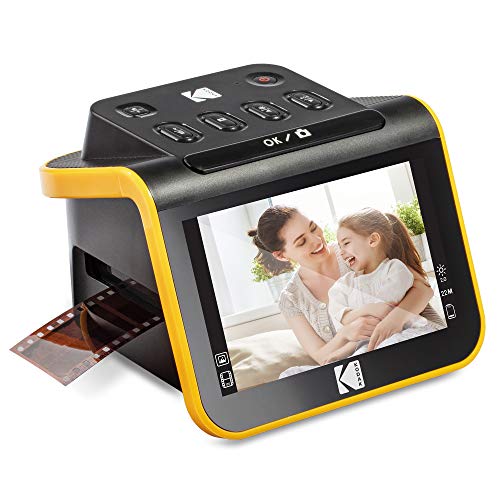
- Scans 135, 110, and 126 film plus 50mm slides
- 5-inch LCD supports previews and gallery viewing
- Saves directly to SD or SDHC cards
Best For: Home users archiving mixed-format family film
Best Professional Detail
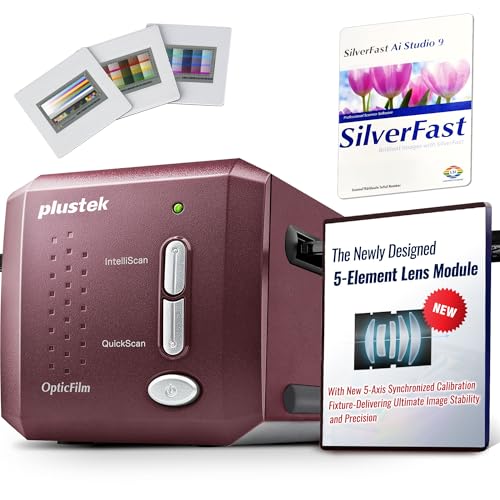
- 7200 dpi optical resolution for detailed 35mm scans
- Infrared dust and scratch removal with SilverFast iSRD
- Includes professional software and IT8 calibration target
Best For: Serious 35mm photographers and archival workflows
Best Fast Standalone Scanner

- Scans multiple film and slide formats
- Creates JPEGs in under five seconds per image
- Works without a computer or editing software
Best For: Beginners digitizing large family collections quickly
Best 35mm Archival Workflow
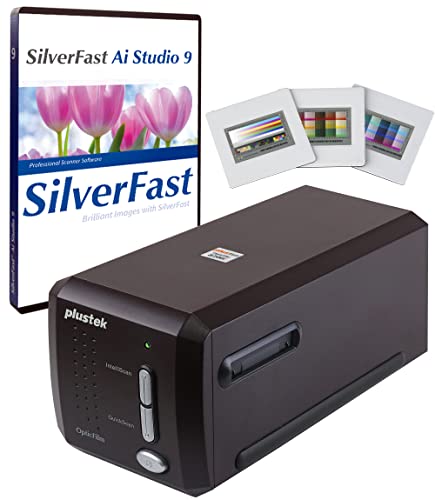
- 7200 dpi scanning for detailed 35mm digitization
- SilverFast 9 adds infrared and HDRi processing
- Includes advanced IT8 calibration target
Best For: 35mm archivists seeking calibrated software control
Best for Simple Home Archiving

- Quick-feeding tray for smoother batch scanning
- Direct SD/SDHC saving without a computer
- Supports 135mm, 110mm, and 126mm film
Best For: Easy home digitization of mixed family film collections
Best for Detailed Film Restoration

- 7200 resolution for detailed scanning
- Infrared dust and scratch detection
- SilverFast software and IT8 calibration target included
Best For: Computer-based archiving of color negatives and slides
Best Standalone Format Flexibility

- Supports 35mm, 110, 126, Super 8, and 8mm
- Up to 24MP capture with a CMOS sensor
- Includes an SD card and needs no computer
Best For: Mixed-format family collections and easy standalone scanning
Flexible Format Pick

- Handles 35mm, 126, 110, Super 8, and 8mm media
- Built-in adjustable 3.5-inch LCD
- One-touch JPEG scanning with included adapters
Best For: Mixed-format home film archives
Batch Archiving Pick
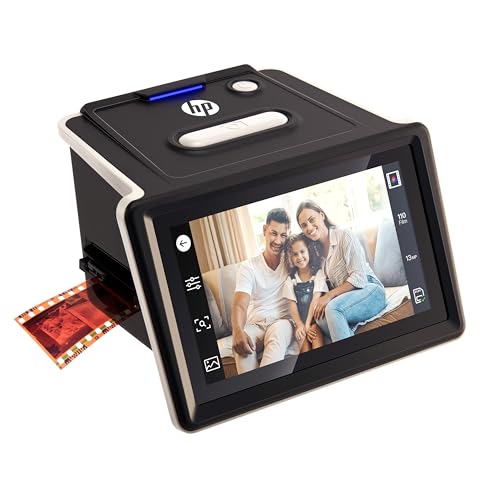
- Standalone scanning without a computer
- 5-inch all-angle touchscreen
- Quick-load tray for larger collections
Best For: Large mixed collections of supported film formats
Compact Starter Pick

- Converts 35mm negatives and slides to JPEG
- Simple standalone plug-and-play operation
- Compact design with 2.4-inch LCD preview
Best For: Beginners with 35mm family archives
Best All-in-One Value – KODAK Slide N Scan
The KODAK Slide N Scan is a practical choice for shoppers seeking film scanners for archiving across several common formats. It handles 135, 110, and 126 negatives plus 50mm slides, and its built-in screen lets you preview and make basic adjustments without a complicated setup.
Best For: Families archiving mixed-format negatives and slides with an easy, computer-light workflow.
Pros:
- Supports 135, 110, and 126 film plus 50mm slides.
- Large 5-inch LCD with gallery mode for previewing scans.
- Can save files directly to an SD or SDHC card up to 32GB.
- Includes film adapters, a cleaning brush, USB cable, and HDMI cable.
Cons:
- SD card is not included.
- Its 24-bit color depth is less suited to demanding professional restoration work.
With broad format support and simple on-device controls for color, brightness, resizing, and date/time information, this model is well suited to straightforward home archiving.
Best Professional Detail – Plustek OpticFilm 9000i Ai
For photographers comparing film scanners for archiving at a professional level, the Plustek OpticFilm 9000i Ai emphasizes detail, calibration, and restoration. Its 7200 dpi optical resolution, 48-bit color depth, infrared processing, and included software are designed for high-quality 35mm digitization.
Best For: Photographers, studios, and serious film enthusiasts archiving 35mm negatives and slides with maximum image control.
Pros:
- True optical resolution up to 7200 dpi captures fine film detail.
- Infrared dust and scratch removal works with SilverFast iSRD.
- Includes SilverFast Ai Studio, QuickScan Plus, and an advanced IT8 target.
- Five-axis factory calibration supports consistent focus and image quality.
Cons:
- Supports 35mm film rather than a broad range of consumer formats.
- Requires a computer and compatible Windows or macOS software.
- Its professional feature set may be more than casual users need.
The 9000i Ai is the strongest fit here for archival projects where accurate color, fine grain detail, and reduced dust-retouching work matter more than quick, standalone operation.
Best Fast Standalone Scanner – Magnasonic FS71
The Magnasonic FS71 is a convenient option for film scanners for archiving when speed and simplicity are priorities. It converts several film and slide formats to JPEG files, offers on-device adjustments, and can save to an SD card without requiring a computer or editing software.
Best For: Beginners and families who want quick scans, broad format support, and simple standalone operation.
Pros:
- Supports 35mm, 110, 126, and Super 8 negatives, plus 135, 126, and 110 slides.
- Scans can take less than five seconds each.
- 5-inch display allows direct viewing and basic RGB and brightness adjustments.
- SD card slot supports expandable storage up to 128GB.
Cons:
- SD card is not included.
- HDMI cable for TV or monitor viewing is not included.
- Produces JPEG files and offers 24-bit color rather than a professional raw archival workflow.
Its fast-loading trays, standalone controls, and wide format compatibility make the FS71 a sensible pick for digitizing a large household collection without installing drivers or buying separate software.
Best 35mm Archival Workflow – Plustek OpticFilm 8300i Ai
The Plustek OpticFilm 8300i Ai is built for users who want film scanners for archiving with detailed software-based control. It combines 7200 dpi scanning with SilverFast 9, infrared image processing, HDRi, multi-exposure, and an advanced IT8 target for more consistent 35mm color calibration.
Best For: 35mm archivists who want professional software tools and repeatable color results.
Pros:
- 7200 dpi resolution is suited to detailed 35mm slide and film scans.
- SilverFast 9 includes iSRD, HDRi, multi-exposure, and NegaFix tools.
- Includes three-slide advanced IT8 calibration target.
- New-generation processing increases scan speed by 38% over the previous model.
Cons:
- Designed for 35mm media rather than multiple consumer film sizes.
- Requires Windows or macOS and a computer-based workflow.
- The extensive software features may involve a steeper learning curve.
For users focused on consistent, high-detail 35mm archiving, the 8300i Ai offers a strong balance of optical resolution, calibration hardware, and restoration-oriented software.
Best for Simple Home Archiving – KODAK Slide N Scan Max
For shoppers comparing film scanners for archiving, the KODAK Slide N Scan Max emphasizes a straightforward, computer-free workflow. Its quick-feeding tray, broad film-format support, SD-card saving, and large tiltable display make it practical for digitizing mixed family collections.
Best For: Home users who want easy scanning of 135mm, 110mm, and 126mm negatives and slides.
Pros:
- Quick-feeding tray supports continuous scanning without repositioning every frame.
- Saves scans directly to SD/SDHC cards up to 32GB, so a computer is not required.
- Includes one-touch resizing, conversion, and image adjustments.
- 7-inch tiltable LCD provides convenient previewing and doubles as a digital picture frame.
Cons:
- Its listed 3200 dpi resolution may be less suited to users seeking the highest-detail archival scans.
- Supported film formats are limited to 135mm, 110mm, and 126mm in the supplied specifications.
The KODAK is a convenience-focused choice for casual-to-moderate home archiving, especially when simple controls and direct SD-card storage matter more than advanced computer-based processing.
Best for Detailed Film Restoration – Plustek OpticFilm 8200i Ai
For film scanners for archiving that prioritize control and image correction, the Plustek OpticFilm 8200i Ai offers 7200 resolution, an infrared dust-and-scratch detection channel, HDRi capture, and bundled SilverFast Ai Studio software. It is designed for a computer-connected workflow rather than quick standalone scanning.
Best For: Experienced archivists and photographers working with color negatives and slides who want calibration and restoration tools.
Pros:
- Built-in infrared detection can help remove dust and scratches without manual retouching.
- Includes SilverFast Ai Studio 8 and an IT8 calibration target for color accuracy.
- 7200 resolution and HDRi capture support detailed, data-rich scans.
- Works with Windows 7/8/10 and Mac OS 10.12 through 14.x according to the supplied notes.
Cons:
- Infrared defect removal does not work with black-and-white negatives.
- Requires a computer and downloaded drivers, making it less convenient than standalone LCD scanners.
- The feature-rich software workflow may take more time to learn.
The Plustek is the strongest fit here for users building a carefully managed archive and willing to trade plug-and-play convenience for higher resolution, calibration, and correction options.
Best Standalone Format Flexibility – BEONEGLOBAL ClearScan P7
Among film scanners for archiving, the BEONEGLOBAL ClearScan P7 stands out for standalone operation and unusually broad format support. It can scan 35mm, 110, 126, Super 8, and 8mm film, preview results on a 7-inch LCD, and save JPEG files to the included SD card without a computer.
Best For: Families with mixed slide, negative, and movie-film formats who want an accessible all-in-one scanner.
Pros:
- Supports 35mm/135, 110, 126, Super 8, and 8mm film and slides.
- Up to 24MP capture uses a 1/2.3-inch CMOS sensor for detailed digital images.
- 7-inch LCD enables immediate previewing, adjustment, and browsing.
- Includes a branded SD card for starting scans out of the box.
Cons:
- The supplied notes specify JPEG output rather than advanced archival file formats.
- Its one-touch workflow offers less documented fine-control and restoration capability than dedicated computer-based scanners.
The ClearScan P7 is a practical choice when convenience and format coverage are priorities. Its included card and no-computer setup reduce friction for large, varied personal collections.
Flexible Format Pick – KODAK SCANZA Renewed
For shoppers comparing film scanners for archiving, the renewed KODAK SCANZA is a flexible option for converting several older film formats directly to JPEG files. Its built-in display, included adapters, and one-touch controls support straightforward scanning without requiring a computer for the basic process.
Best For: Home archivists with mixed collections of 35mm, 126, 110, Super 8, and 8mm negatives or slides.
Pros:
- Supports multiple film and slide formats with included inserts and adapters.
- Large, adjustable 3.5-inch TFT LCD with tilt adjustment for viewing.
- One-touch scanning and JPEG saving, with RGB and resolution editing options.
- Offers HDMI and USB connectivity and supports SD cards up to 128GB.
Cons:
- SD card is not included.
- Renewed product includes a 90-day limited warranty.
The SCANZA stands out when format compatibility and simple controls matter more than a computer-based workflow. Its broad adapter selection makes it especially practical for varied family archives.
Batch Archiving Pick – HPFS500 Film & Slide Scanner
The HPFS500 is a practical choice for film scanners for archiving when you want a standalone workflow and a larger preview screen. It digitizes supported negatives and slides without a computer, while its quick-load tray helps keep larger scanning sessions moving.
Best For: Users digitizing substantial collections of 135, 126, and 110 negatives and positive slides.
Pros:
- Standalone operation avoids requiring a computer during scanning.
- 5-inch all-angle touchscreen supports previewing and editing on the device.
- Supports 135, 126, and 110 negatives and positive slides.
- Quick-load tray is designed for more efficient batch scanning.
Cons:
- Its listed operating-system requirements apply when using a computer: Windows 10 or later and macOS 10.15 or later.
- Listed resolution combines a 13MP CMOS sensor with 22MP interpolation.
Choose the HPFS500 if hands-on touchscreen control and collection throughput are priorities. The standalone design and quick-load tray make it well suited to organized archival projects.
Compact Starter Pick – DigitConvert 35mm Scanner
For basic film scanners for archiving, this compact DigitConvert model offers a simple way to turn 35mm negatives and slides into JPEG files. Its standalone design, built-in preview screen, and USB transfer make it approachable for home users who want minimal setup.
Best For: Beginners archiving 35mm family negatives and slides with a small, portable device.
Pros:
- Converts 35mm negatives and slides to 5MP or 10MP JPEG images.
- Plug-and-play operation does not require complex software or drivers.
- 2.4-inch LCD supports previewing, flipping, mirroring, and brightness adjustment.
- Includes film and slide adapters and supports USB transfer to PC or Mac.
Cons:
- Supports 35mm film and slides rather than the broader range offered by some models.
- SD card up to 32GB is required for saving images and is not included.
- Has a smaller 2.4-inch screen and listed 1800 dpi resolution.
This model is best suited to straightforward 35mm digitization rather than high-volume or multi-format archiving. Its compact size and simple controls can make it a convenient starting point for family photo projects.
How We Picked These Film Scanners for Archiving
We focused on scanners that support common film formats and offer a practical path from physical originals to digital files. Selection factors included supported formats, stated scan resolution, preview-screen usability, connection options, included software, color-management features, and the amount of manual control available.
The list includes both standalone scanners for convenient home projects and dedicated 35mm film scanners intended for more detailed archival work. Because advertised megapixel counts do not always reflect final image quality, we also considered workflow, alignment, dust reduction, and software support.
Quick Comparison
| Best For | Look For | Typical Advantage |
|---|---|---|
| Large family collections | Fast loading and built-in display | Simple, independent operation |
| 35mm photography | Dedicated film optics and high optical resolution | More detailed scans |
| Mixed film formats | Support for 35mm, 110, 126, and movie film | Greater versatility |
| Color-critical archiving | IT8 targets and calibration software | More consistent color |
| Occasional scanning | USB-powered, compact design | Lower setup and storage demands |
Key Buying Factors for Film Scanners for Archiving
Resolution and Real-World Detail
Check whether a product emphasizes interpolated megapixels or optical resolution. Optical performance, lens quality, focus accuracy, and consistent film positioning often matter more than the largest number on the box. Higher detail is especially useful when you plan to crop, print, or restore small 35mm frames.
Format Compatibility
Confirm that the scanner accepts the film you actually own. Some models handle only 35mm negatives and slides, while all-in-one units may also support 110, 126, Super 8, or 8mm formats. Adapters can make a major difference when scanning a varied family archive.
Color, Dust, and Software Control
For serious preservation, look for adjustable exposure, color correction, calibration support, and dust or scratch reduction. IT8 compatibility can help achieve more dependable color, while basic scanners may be better suited to quick sharing than restoration-grade results.
Workflow and File Handling
A built-in LCD and internal storage or memory-card support can simplify batch scanning. USB connectivity is useful for transferring files directly to a computer. Also check file formats, scan speed, included holders, power requirements, and whether the software works with your operating system.
Who Should Buy Which Film Scanners for Archiving?
Choose an all-in-one LCD scanner if you want the easiest way to digitize a mixed collection with minimal computer setup. These models are convenient for family archives, casual sharing, and batches where speed matters more than fine editing.
Choose a dedicated Plustek-style 35mm scanner if image detail, alignment, color accuracy, and editing flexibility are priorities. It is the better direction for photographers, collectors, and anyone creating high-quality master files from valuable slides or negatives.
Compact USB scanners make sense for occasional users with limited storage space, while a model supporting several film formats is preferable for inherited collections. Before buying, count your frames, identify every format, and decide whether you need quick reference scans or preservation-quality files you can print and edit later.