Digitizing negatives can preserve family memories, simplify photo editing, and make old film easier to share. The best negative scanners for PC balance image quality, format support, scanning speed, and straightforward file transfer.
We selected 10 options ranging from dedicated 35mm film scanners to all-in-one models with built-in displays and support for multiple film sizes. Use the guide below to match features and workflow to your needs.
Best 10 Negative Scanners for PC Picks for 2026
Best High-Resolution Pick

- 7200 dpi scanning for 35mm film
- Infrared dust and scratch detection
- Includes SilverFast SE Plus 9
Best For: Detailed 35mm scans on Windows or Mac
Best Standalone Value
Photo, Slide & Negative Scanner

- Works without a computer
- Large 5-inch viewing screen
- Includes SD card and scanning accessories
Best For: Easy home archiving of film, slides, and photos
Best Medium-Format Support
Professional 22MP Film Scanner

- Supports 35mm and several medium formats
- Up to 22MP JPEG output
- Built-in memory and SD card storage
Best For: Mixed-format film collections
Best Compact HP Option
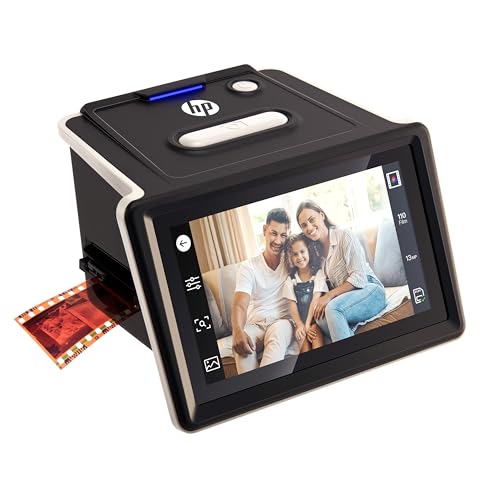
- Standalone scanning with a 5-inch touchscreen
- Supports 135, 126, and 110 film
- Quick-load tray for faster sessions
Best For: Compact home scanning of mixed film collections
Best All-in-One Pick
Magnasonic FS71 24MP Film Scanner

- Supports 35mm, 110, 126, and Super 8 film
- 24MP JPEG scans with onboard adjustments
- 5-inch display and SD storage up to 128GB
Best For: Broad-format home scanning without a computer
Best for Easy Viewing

- Large tiltable 7-inch LCD preview screen
- Quick-feeding tray for continuous scanning
- Supports 135mm, 110mm, and 126mm film
Best For: Simple family archiving with comfortable previewing
Best Compact High-Resolution Option

- Up to 24MP scans with a CMOS sensor
- Supports four film formats, including Super 8
- Built-in memory, SD storage, and USB transfer
Best For: High-resolution scanning with flexible file storage
Best No-Computer Pick
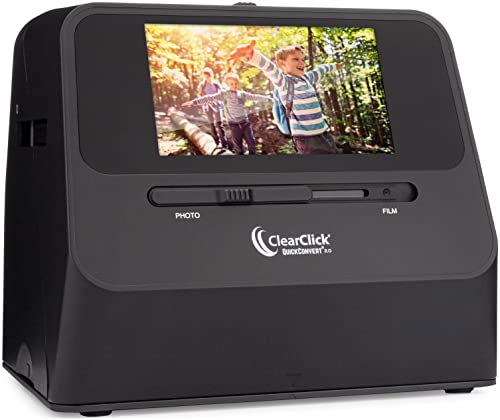
- Scans 35mm, 110, and 126 film
- Works without a computer or drivers
- Built-in battery and 5-inch LCD
Best For: Standalone scanning of film and small photos
Best Format Flexibility
KODAK SCANZA Film & Slide Scanner
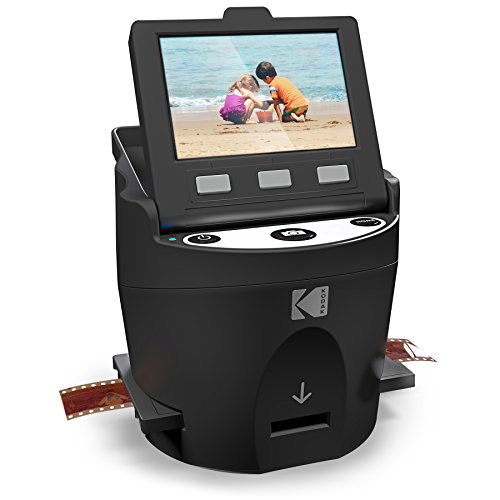
- Supports five listed film formats
- Includes film inserts and adapters
- 3.5-inch adjustable LCD display
Best For: Digitizing varied compatible film collections
Best Compact Option

- Compact 16MP film scanner
- Supports 126 and 135 film
- Built-in editing and 2.31-inch LCD
Best For: Portable scanning in small spaces
Best High-Resolution Pick – Plustek OpticFilm 8200i SE
For shoppers seeking negative scanners for PC use, the Plustek OpticFilm 8200i SE is a dedicated 35mm option with very high stated resolution, infrared dust and scratch detection, and support for both Windows and Mac systems.
Best For: PC users digitizing 35mm negatives and mounted slides who want detailed scans and built-in defect removal.
Pros:
- 7200 x 7200 dpi resolution with 48-bit input.
- Infrared channel helps detect dust and scratches.
- Includes SilverFast SE Plus 9 and Plustek QuickScan software.
- Supports Windows 7 through 11 and Mac OS 10.7 through 14.x.
Cons:
- Designed for 35mm film and mounted slides rather than multiple film formats.
- Requires a computer and USB connection for operation.
This is the strongest choice here for users prioritizing resolution and software-assisted cleanup. Its dedicated format and computer-based workflow make it less convenient for casual, standalone scanning.
Best Standalone Value – Photo, Slide & Negative Scanner
Among negative scanners for PC, this all-in-one model stands out for convenience: it scans without a computer, previews images on a large screen, and transfers saved files to a PC or Mac through USB.
Best For: Families and beginners who want a simple way to digitize 35mm and 110 film, slides, and printed photos.
Pros:
- Standalone operation with no computer, apps, or drivers required.
- Large 5-inch HD viewing screen for previewing and editing.
- Supports 35mm, 135, and 110 negatives, plus printed photos and business cards.
- Includes an 8GB SD card, holders, trays, cleaning brush, and USB cable.
Cons:
- Its stated resolution is 1080P, below the Plustek’s 7200 dpi specification.
- The included SD card provides limited storage for larger archives.
The large screen and one-touch workflow make this an approachable option for home archiving. Choose it over a dedicated PC scanner when convenience and broad media support matter more than maximum scan resolution.
Best Medium-Format Support – Professional 22MP Film Scanner
For shoppers comparing negative scanners for PC and broader film archives, this model supports 35mm plus several medium-format sizes. It saves JPEG files to built-in memory or an SD card and offers basic adjustments directly on the device.
Best For: Film enthusiasts who need support for 135, 120, 127, and 126K negatives and slides.
Pros:
- Supports 35mm, multiple 120 formats, 127, and 126K film.
- Produces JPEG files at up to 22 million pixels.
- Offers preview, playback, exposure, brightness, and color adjustments.
- Includes 128MB of built-in memory and supports SD cards up to 32GB.
Cons:
- SD card is not included.
- The notes identify Bluetooth rather than a standard PC-focused USB connection.
- Its broad format support may be unnecessary for users scanning only 35mm film.
This is the most flexible pick for mixed-format collections. Its direct-to-memory workflow is convenient, but buyers wanting a clearly documented USB computer connection should verify compatibility before purchasing.
Best Compact HP Option – HP FilmScan HPFS500
The HP FilmScan HPFS500 is a practical choice among negative scanners for PC when you want standalone scanning with a compact design. Its touchscreen, quick-load tray, and support for common 135, 126, and 110 formats suit home collection projects.
Best For: Users digitizing mixed collections who want a small scanner with touchscreen controls and efficient loading.
Pros:
- Scans without a computer through a standalone workflow.
- 5-inch all-angle touchscreen enables preview and image adjustments.
- Supports 135, 126, and 110 negatives and positive slides.
- Quick-load tray helps streamline batch scanning.
Cons:
- The 13MP CMOS sensor and 22MP interpolation may not satisfy users seeking the highest native detail.
- Requires Windows 10 or later or macOS 10.15 or later for listed computer compatibility.
- Uses a 24-bit color depth specification.
HP’s compact design and touchscreen controls make this a convenient archive tool, especially for varied film formats. It is better suited to straightforward home digitization than demanding, high-end restoration work.
Best All-in-One Pick – Magnasonic FS71 24MP Film Scanner
The Magnasonic FS71 is a practical choice among negative scanners for PC, especially if you want to digitize several film formats without relying on a computer during scanning. It supports 35mm, 110, 126, and Super 8 film, along with multiple slide formats, and saves JPEG files to an SD card.
Best For: Users who want broad format support, quick scans, and built-in viewing and editing controls.
Pros:
- Scans supported film and slides into high-resolution 24MP JPEG files.
- Works without a computer or photo-editing software.
- Includes a large 5-inch display, HDMI output, and SD card storage support up to 128GB.
- Scans photos in less than five seconds each, according to the supplied product details.
Cons:
- HDMI cable and SD card are not included.
- The listed minimum system requirement is Windows 7, which may be limiting for some PC setups.
Choose this model if convenience and format flexibility matter more than a computer-dependent workflow. Its onboard adjustments and direct SD-card saving make it straightforward for large home digitization projects.
Best for Easy Viewing – KODAK Slide N Scan Max
The KODAK Slide N Scan Max is one of the more accessible negative scanners for PC, with a quick-feeding tray and simple one-touch editing. Its 7-inch tiltable LCD makes it easy to preview scans, while direct SD/SDHC saving lets you create a digital archive without keeping a computer connected.
Best For: Families digitizing mixed collections of 135mm, 110mm, and 126mm film and slides.
Pros:
- Quick-feeding tray supports a smoother continuous-scanning workflow.
- Handles 135mm, 110mm, and 126mm film formats.
- Features a large, tiltable 7-inch LCD that can also function as a digital picture frame.
- Saves scans directly to SD/SDHC cards up to 32GB.
Cons:
- SD storage support is limited to 32GB.
- The supplied connection details list USB but do not specify HDMI output.
This is a strong fit for users who prioritize a clear preview screen and uncomplicated controls. The feeding tray and one-touch editing are useful when scanning a substantial family collection with minimal setup.
Best Compact High-Resolution Option – BEONEGLOBAL ClearScan S5
The BEONEGLOBAL ClearScan S5 is a compact option among negative scanners for PC, combining 24MP capture with a 5-inch LCD and one-touch controls. It supports 135, 126, 110, and Super 8 negatives and slides, then stores images in built-in memory, on an SD card, or through USB transfer.
Best For: Users seeking high-resolution scans, straightforward controls, and flexible storage options.
Pros:
- Uses a 1/2.3-inch CMOS sensor for up to 24MP scans.
- Supports 135, 126, 110, and Super 8 negatives and slides.
- Includes a 5-inch LCD with front-panel controls for previewing and adjustments.
- Offers built-in 128MB memory, SD-card support up to 32GB, and USB transfer.
Cons:
- SD card is not included.
- Its listed SD-card capacity is lower than the Magnasonic FS71’s stated maximum.
The ClearScan S5 makes sense when image resolution and storage flexibility are key priorities. Its one-touch workflow and purpose-built film holders help keep the process simple while retaining the option to move files to a PC through USB.
Best No-Computer Pick – ClearClick QuickConvert 2.0
For shoppers comparing negative scanners for PC, the ClearClick QuickConvert 2.0 is a flexible option that can also work without a computer. It scans 35mm, 110, and 126 negatives, slides, and photos directly to an SD card, with a built-in display for previewing results.
Best For: Users who want cord-free, standalone scanning for film and small photos.
Pros:
- Scans several film formats plus photos up to 4×6 inches.
- Requires no computer or drivers for basic scanning.
- Built-in rechargeable battery and 5-inch preview LCD support portable use.
- Scans in about 2–3 seconds and includes a two-year warranty.
Cons:
- Scans one item at a time and has no autofeeder.
- Does not support 5×7 photos.
- SD memory card is needed to save JPEG files.
The QuickConvert 2.0 is a practical choice when convenience matters more than batch scanning. Its broad format support and large preview screen make it easy to digitize mixed collections without setting up a PC.
Best Format Flexibility – KODAK SCANZA Film & Slide Scanner
The KODAK SCANZA is a strong contender among negative scanners for PC when you need support for multiple film formats. It converts 35mm, 126, 110, Super 8, and 8mm negatives and slides to JPEG files, while its LCD and included adapters simplify scanning.
Best For: Families digitizing several compatible film and slide formats with a PC or Mac.
Pros:
- Supports 35mm, 126, 110, Super 8, and 8mm film.
- Includes multiple inserts and adapters for flexible operation.
- Large 3.5-inch adjustable LCD makes previewing convenient.
- Offers image adjustments for RGB and resolution and includes a cleaning brush.
Cons:
- SD card is not included.
- Only the listed film formats are supported.
- Requires external power through the included adapter or USB cable.
Choose the SCANZA if format compatibility is your priority. Its included accessories and Mac and PC compatibility make it well suited to households with varied film archives.
Best Compact Option – BEONEGLOBAL ClearScan MINI
The BEONEGLOBAL ClearScan MINI is a compact choice for shoppers seeking negative scanners for PC without a bulky setup. It digitizes 126 and 135 film and slides at up to 16MP, saves to an SD card, and includes basic editing controls on its 2.31-inch screen.
Best For: Portable scanning of 126 and 135 film when space and easy handling matter.
Pros:
- Compact, lightweight design weighs about 10 ounces.
- 16MP CMOS sensor is designed for detailed film scans.
- Built-in controls adjust brightness, color, orientation, and rotation.
- Compatible with Windows XP through Windows 10 and Mac OS 10.7.3 or later.
Cons:
- Supports 126 and 135 film rather than the broader range offered by some models.
- SD card is not included and capacity is limited to 32GB.
- Smaller 2.31-inch screen provides less viewing area than larger models.
The ClearScan MINI makes sense for occasional scanning, travel, or tight workspaces. Its straightforward controls and built-in editing are useful, provided your collection is limited to its supported film formats.
How We Picked the Best Negative Scanners for PC
We compared these scanners by looking at the features that matter most when converting film to digital files. Resolution and color depth help determine how much detail a scanner can capture, while infrared dust and scratch removal can reduce cleanup on compatible film. We also considered supported formats, display size, connection options, included holders, ease of use, and whether a computer is required.
The selection includes dedicated 35mm models for detail-focused users, as well as standalone scanners that handle slides, negatives, and multiple film formats. Because advertised resolution does not always equal practical output quality, buyers should consider the complete workflow rather than relying on a single specification.
Quick Comparison
- Best for maximum 35mm detail: Choose a dedicated high-resolution film scanner with strong color depth and dust-removal technology.
- Best for convenience: Select a model with a large LCD, simple controls, and direct memory-card or USB saving.
- Best for mixed formats: Look for support for 35mm, 110, 126, Super 8, or 8mm film, depending on your archive.
- Best for PC editing: Prioritize USB connectivity, compatible software, and image files that transfer easily to your computer.
Key Buying Factors for Negative Scanners for PC
Resolution and Image Quality
Higher optical resolution can reveal more detail from small 35mm frames, especially when cropping or making larger prints. A high megapixel rating may be useful for standalone scanners, but sensor quality, lens performance, focus, and accurate color reproduction also affect results.
Film and Slide Compatibility
Check the supported formats before buying. Some scanners focus on 35mm negatives and slides, while others also accept 110, 126, Super 8, or 8mm film. Confirm that the included holders match the film types in your collection.
Computer Connection and Workflow
For PC-based editing, verify the USB connection, operating-system compatibility, file format, and included software. Standalone models can be faster for casual archiving, but direct-to-card workflows may provide fewer editing controls than a dedicated computer-connected scanner.
Dust Removal and Handling
Infrared cleaning can be valuable for compatible color film, although it may not work with every film type. Look for sturdy holders and a design that keeps film flat and aligned to reduce crooked scans and repeated handling.
Who Should Buy Which Negative Scanners for PC?
Choose a dedicated 35mm scanner if image quality, fine detail, and computer editing are your top priorities. These models are generally better suited to photographers, archivists, and users planning to print or heavily crop their scans.
Choose an all-in-one scanner with a large screen if you want quick previews and simple operation without constantly using a monitor. These are practical for family archives and occasional scanning.
Choose a multi-format model if your collection includes several film sizes or movie-film formats. Confirm the exact supported standards before ordering, since format labels can vary between products.
Choose a compact, standalone option for portability and straightforward transfers. It may be the better fit for casual users, provided its output quality and storage method meet your expectations.