Accurate color starts with dependable measurement. The right calibration tool can help photographers, designers, print professionals, and paint specialists reduce guesswork and maintain more consistent results.
This roundup compares 10 options across monitor calibration, camera and video workflows, print quality control, and portable paint matching, so you can choose equipment suited to your work and budget.
Best 10 Spectrophotometer Color Calibration Tools Picks for 2026
Complete Workflow Pick

- Profiles displays, printers, cameras, and scanners
- Includes ColorChecker Classic Mini target
- Measures ambient light for print matching
Best For: Camera-to-print color management
Advanced Display Pick

- Supports current HDR and OLED display types
- Offers projector calibration and 3D LUT export
- Includes multi-monitor matching tools
Best For: Advanced display and video calibration
Portable Measurement Pick

- Measures physical colors for print and packaging
- Reports CMYK, RGB, HEX, and Delta-E data
- Connects with the Nix Toolkit app
Best For: Portable print, paint, and coating measurement
Print QC Specialist

- Dedicated 2mm jig for print control strips
- Compact alternative to higher-cost benchtop devices
- Requires the targeting jig for operation
Best For: Print and packaging color quality control
Pro Creator Workflow

- Calibrates displays up to 10,000 nits
- Includes ColorChecker Passport Video 2
- Supports camera matching and white-balance setup
Best For: Photo and video creators using high-brightness displays
Portable Production Matcher
Spectro 3 Mobile Spectrophotometer
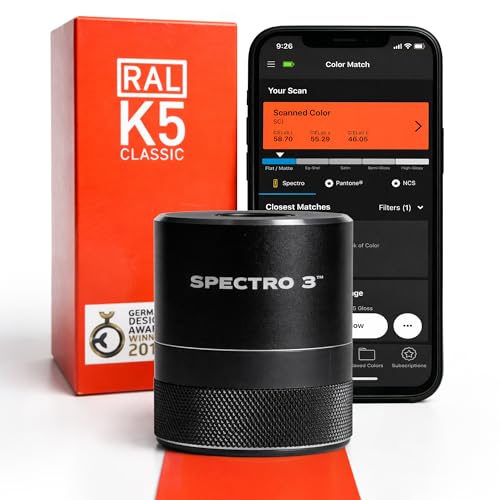
- Combines color and 60° gloss measurement
- Handles paints, plastics, textiles, leather, and print
- Offers 1,000+ readings per charge with UV detection
Best For: Mobile material matching and production QC
Portable Paint Matching Tool

- Designed for professional paint color matching
- Connects wirelessly to iOS and Android
- Includes pouch, cable, and lithium-ion battery
Best For: On-site paint scanning for designers and contractors
Simple Monitor Calibration Pick

- Guided Easy 1 2 3 calibration workflow
- Supports up to two displays
- Includes before-and-after accuracy check
Best For: Photographers and creators wanting simple monitor calibration
Complete Workflow Pick – ColorChecker Studio
The Calibrite ColorChecker Studio is an all-in-one spectrophotometer color calibration tool for photographers who need consistent color from camera capture through editing and print. Its PROFILER software supports displays, projectors, printers, paper, scanners, and custom camera profiling.
Best For: Photographers and creative professionals managing camera-to-print color workflows.
Pros:
- Profiles monitors, projectors, printers, paper, cameras, and scanners.
- Includes a ColorChecker Classic Mini for custom RAW camera profiles.
- Adaptive iterative profiling helps optimize results for individual displays.
- Ambient light measurement supports more reliable print-to-screen comparisons.
Cons:
- Its broad feature set may be more than users who only calibrate a monitor need.
- Camera profiling requires using the included target with the PROFILER software.
Choose this model when your workflow extends beyond screen calibration. It is particularly practical for users who want one device to coordinate capture, display, and output color.
Advanced Display Pick – SpyderPro Monitor Calibrator
The SpyderPro is a display-focused spectrophotometer color calibration tool for photographers, designers, and video editors. It supports modern backlight technologies, advanced grayscale measurement, projector calibration, display analysis, and 3D LUT export for compatible video monitors.
Best For: Professionals calibrating multiple modern displays for photo, design, video, or presentation work.
Pros:
- Supports OLED, Mini LED, QD-OLED, Apple Liquid Retina XDR, and other display types.
- Measures displays up to 12,000 nits and offers a deeper calibration mode.
- Includes projector calibration, display analysis, and 3D LUT export.
- USB-C connectivity includes a USB-A adapter for broader computer compatibility.
Cons:
- Its display-analysis features may be unnecessary for basic single-monitor calibration.
- Advanced functionality depends on the Spyder software workflow and compatible video monitors.
The SpyderPro is a strong choice for demanding display setups, especially when brightness, HDR support, multi-monitor matching, and ongoing calibration checks matter.
Portable Measurement Pick – Nix Spectro 2
The Nix Spectro 2 is a portable spectrophotometer color calibration tool designed for measuring physical colors in print, packaging, paint, coatings, and related applications. It works with the Nix Toolkit app to report CMYK, ink density, RGB, HEX, and Delta-E data.
Best For: Print, packaging, paint, and graphics professionals who need portable physical color measurement.
Pros:
- Scans across 31 UV-visible channels at one measurement per second.
- Provides CMYK, ink density, RGB, HEX, and Delta-E information.
- Portable design offers an alternative to larger benchtop color measurement equipment.
- The app provides access to a large library of paint colors.
Cons:
- Enhanced print QA features require the separately available Nix Print Pro software.
- Pantone, RAL, and NCS library compatibility is available through a subscription.
- It is intended for physical color measurement rather than monitor profiling.
Consider the Spectro 2 when portability and physical-sample measurement are more important than calibrating a display. It is well suited to field checks and production color workflows.
HDR Display Pick – Calibrite Display Plus HL
The Calibrite Display Plus HL is a high-luminance spectrophotometer color calibration tool for HDR-capable monitors and other very bright displays. Its sensor measures up to 10,000 nits, while PROFILER software provides display controls, video-standard support, and validation tools.
Best For: Video editors, colorists, and creators calibrating Mini LED, OLED, Apple XDR, or other bright displays.
Pros:
- Measures luminance up to 10,000 nits for bright HDR displays.
- Supports LCD, Mini LED, OLED, Apple XDR, and compatible projectors.
- Offers Rec.709, Rec.2020, and BT.1886 workflow support.
- Includes profile validation, uniformity checks, and multi-monitor profiling.
Cons:
- Its high-luminance capabilities may be unnecessary for standard-brightness screens.
- It is focused on display and projector profiling rather than camera or printer profiling.
This model makes the most sense for HDR and professional video environments where ordinary calibration hardware may not cover the display’s brightness range. Its validation tools also help verify results across multiple screens.
Print QC Specialist – Nix Spectro 2 (2mm)
The Nix Spectro 2 (2mm) is a targeted choice among spectrophotometer color calibration tools for print professionals who need repeatable measurements from control strips. Its dedicated jig helps position the device accurately, while optional software supports a more connected print-quality workflow.
Best For: Print and packaging professionals measuring color for quality control.
Pros:
- Purpose-built 2mm targeting jig for print control strips.
- Designed to provide accurate data in a compact, cost-conscious device.
- Works with the free Nix Toolkit app and can integrate with optional Nix Print Pro software.
- Includes a ceramic tile, case, USB-C cable, pouch, and lanyard.
Cons:
- Not recommended for general users outside the print industry.
- Will not function without the targeting jig.
- Nix Print Pro software and enhanced Pantone, RAL, and NCS access may require additional purchase or subscription.
This is a focused print-QC instrument rather than a general-purpose color tool. Choose it when precise strip positioning and print workflow compatibility matter more than broad, unrestricted use.
Pro Creator Workflow – Calibrite Video Photo Kit
The Calibrite Video Photo Kit combines a high-luminance colorimeter with a camera reference target, making it a versatile option among spectrophotometer color calibration tools for photo and video workflows. It supports monitor profiling, white-balance setup, exposure checks, and camera matching from capture through post-production.
Best For: Photographers and videographers calibrating bright displays and matching cameras.
Pros:
- Display Plus HL measures displays up to 10,000 nits, including mini-LED, OLED, and Apple XDR panels.
- ColorChecker Passport Video 2 provides video color, grayscale, white-balance, and 24-color targets.
- Supports consistent capture and monitor color management across Windows and macOS workflows.
- Includes access to Calibrite PROFILER software and protective accessories.
Cons:
- Software download is required.
- Its creator-focused kit may offer more equipment than users seeking monitor calibration alone need.
- The supplied notes do not specify support for mobile operating systems.
This kit is strongest when display calibration and in-camera reference are both part of the workflow. Its 10,000-nit capability makes it especially relevant for creators working with modern high-brightness panels.
Portable Production Matcher – Spectro 3 Mobile Spectrophotometer
The Spectro 3 is a portable option among spectrophotometer color calibration tools, combining color measurement with 60° gloss readings. Its dual optical geometries, UV detection, and mobile-app connectivity make it suitable for checking varied real-world materials in production or field settings.
Best For: Manufacturing, quality-control, and field professionals matching paint and other materials.
Pros:
- Measures color and 60° gloss in one device.
- Supports paints, plastics, fabrics, leather, and printed materials.
- Uses 45/0° and d/8° optical geometries for complex surfaces.
- Provides 1,000+ measurements per charge with built-in UV illumination for fluorescence detection.
Cons:
- Advanced QC Module functionality is optional.
- Requires the Spectro by Variable mobile app for connected data capture and comparison.
- Its broader material and gloss capabilities may be unnecessary for users needing simple color readings only.
Choose the Spectro 3 when portability, gloss measurement, and material flexibility are priorities. The optional QC Module can extend it into production tracking for reference colors and color drift.
High-Luminance Display Specialist – Display Pro HL
For photographers, designers, and studios comparing spectrophotometer color calibration tools, the Calibrite Display Pro HL is designed for modern high-brightness displays. Its sensor measures up to 3000 nits and works with LCD, mini-LED, OLED, Apple XDR displays, and compatible projectors.
Best For: Creative professionals who need advanced profiling, HDR display support, and matched color across multiple screens.
Pros:
- Measures high-luminance displays up to 3000 nits, supporting brighter modern panels and HDR workflows.
- PROFILER software includes Basic and Advanced modes, custom presets, and controls for white point, luminance, contrast ratio, and gamma.
- Includes validation, uniformity, flare-correction, and multi-display workflow tools.
- Supports custom patch sets and includes a USB-C connection, USB-A adapter, and travel pouch.
Cons:
- Its advanced controls may be more than casual users need.
- Designed for Mac and Windows workflows rather than mobile use.
The Display Pro HL is the most capable option here for users working with high-brightness or HDR-capable screens. It is a strong fit when calibration verification and repeatable multi-monitor profiling matter as much as basic color correction.
Portable Paint Matching Tool – Spectro 1 Pro
The Spectro 1 Pro is a handheld option among spectrophotometer color calibration tools, built specifically for paint color matching. It captures color data with professional-grade sensor technology and connects wirelessly to an iOS or Android app for portable use.
Best For: Designers, painters, contractors, and DIY users who need on-site paint scanning and color matching.
Pros:
- Portable spectrophotometer and color reader designed for precise paint matching.
- Works with fan deck libraries from major paint brands.
- Wireless connection to the Spectro App on iOS and Android supports fast, mobile results.
- Includes a USB charging cable, protective pouch, and rechargeable lithium-ion battery.
Cons:
- Its stated use is paint matching rather than monitor calibration.
- Requires the Spectro App and a compatible iOS or Android device for the wireless workflow.
Choose the Spectro 1 Pro when the job involves physical paint surfaces rather than screen profiling. Its compact design and app connectivity make it practical for field measurements and color-matching work away from a studio.
Simple Monitor Calibration Pick – Display 123
For shoppers seeking straightforward spectrophotometer color calibration tools for photo editing, the Calibrite Display 123 emphasizes a guided setup. Its Easy 1 2 3 software workflow calibrates up to two displays and includes a before-and-after comparison to help confirm the result.
Best For: Photographers and creators who want approachable monitor calibration without a long list of manual controls.
Pros:
- Guided Easy 1 2 3 workflow makes setup accessible to newer users.
- Supports calibration of up to two monitors for more consistent viewing across a workspace.
- Offers Native or Photo brightness targets and a built-in before-and-after check.
- Compact USB-C colorimeter includes an adjustable counterweight for screen placement.
Cons:
- Supports fewer displays than the Display Pro HL.
- The simplified workflow provides fewer advanced customization details in the supplied specifications.
The Display 123 is a sensible choice when ease of use is the priority. It covers core monitor calibration needs for photo and creative work while keeping the process simple enough to repeat regularly.
How We Picked These Spectrophotometer Color Calibration Tools
We selected products based on their intended use, measurement capability, supported workflows, portability, display compatibility, software features, and ease of setup. The list includes dedicated spectrophotometers, monitor colorimeters, and bundled systems because “calibration tool” can mean different things depending on whether you work with screens, printers, cameras, packaging, or coatings.
For professional purchasing, confirm the product’s supported operating system, connection method, software requirements, measurement range, and target-size compatibility before ordering. A monitor colorimeter is not a substitute for a handheld spectrophotometer when you need physical-sample measurements.
Quick Comparison
- Complete display, projector, printer, and scanner profiling: Calibrite ColorChecker Studio is the broadest all-in-one choice in this selection.
- Monitor calibration: SpyderPro, Calibrite Display Plus HL, Display Pro HL, and Display 123 focus on screen accuracy.
- Print and packaging measurement: Nix Spectro 2 models add portable sample measurement, with the 2mm version designed for smaller targets.
- Video and camera workflows: The Calibrite Video Photo Kit combines display calibration with a video color reference target.
- Paint matching: Spectro 3 and Spectro 1 Pro are designed for portable paint color measurement and matching.
Key Buying Factors for Spectrophotometer Color Calibration Tools
Measure the Right Kind of Color
Determine whether you need to profile a monitor or measure a physical surface. Colorimeters are generally built for displays, while spectrophotometers typically read reflected light from materials such as paper, paint, coatings, and packaging. A multifunction system may cover both, but verify the exact supported devices and workflows.
Check Brightness and Display Compatibility
Modern OLED, mini-LED, HDR, and high-brightness displays can exceed the limits of older calibration hardware. If you edit HDR video or use a very bright screen, choose a model whose sensor and software support the display’s brightness range. Also check compatibility with curved, ultra-wide, and multi-monitor setups.
Consider Target Size and Repeatability
Small color patches require accurate positioning and an appropriate aperture or targeting jig. For print and packaging inspection, repeatable readings, measurement geometry, calibration references, and software reporting may matter more than compact size alone.
Review the Complete Workflow
Software quality affects setup, profiling, reporting, and long-term usability. Look for clear guided steps, profile management, export options, cloud or mobile requirements, and compatibility with your editing or production environment.
Who Should Buy Which Spectrophotometer Color Calibration Tools?
Photographers and general display users should prioritize a simple monitor colorimeter such as Display 123. Editors using bright HDR, OLED, or mini-LED screens should consider Display Plus HL or Display Pro HL. Video creators may benefit from the Video Photo Kit’s combined monitor and camera-reference workflow.
Print studios and packaging professionals should look toward the Nix Spectro 2 models or ColorChecker Studio, choosing the 2mm targeting option when small patches are common. Paint designers, retailers, and contractors should choose a dedicated portable matching tool such as Spectro 1 Pro or Spectro 3. If you need the widest range of profiling tasks in one system, ColorChecker Studio is the most versatile starting point.