Wireless video transmission can simplify live production by moving camera footage to a switcher, monitor, recorder, or streaming computer without long cable runs. The right system can improve mobility while preserving the resolution and responsiveness your workflow demands.
This roundup covers 10 video transmitters for live streaming, ranging from compact 1080p HDMI kits to higher-end 4K systems with SDI support, loop-out functionality, multiple receivers, and USB video output.
Best 10 Video Transmitters for Live Streaming Picks for 2026
Best Overall

- 4K30 dual-band transmission with smart channel scanning
- Up to 1,300 feet of range and about 60ms latency
- UVC streaming, HDMI loop-out, and support for up to four receivers
Best For: Live streaming crews and professional multi-monitor production
Best for Simple Setup
TIMBOOTECH Wireless HDMI Extender

- Pre-paired, plug-and-play operation without Wi-Fi or Bluetooth
- Supports up to 4K30 video and audio transmission
- 165-foot stated range plus multi-transmitter pairing
Best For: Presentations, home theater, and basic display extension
Best for Long-Range UVC Streaming

- Stated 1,500-foot range with approximately 0.1-second latency
- UVC output supports computer streaming up to 1080p60
- 20 channels, LCD status displays, loop-out, and five-receiver support
Best For: Outdoor production and long-distance OBS streaming
Best Low-Latency 1080p Option

- 1080p60 transmission with stated 50ms latency
- 656-foot open-space range and HDMI loop-out
- USB-C or NP-F battery power with mobile app preview
Best For: Mobile 1080p filming and responsive live-event monitoring
Easy Home Streaming

- Plug-and-play wireless HDMI with no network or app required
- 4K at 30Hz receiver support and 165-foot line-of-sight range
- Pairs up to eight transmitters with one receiver
Best For: Home theaters, classrooms, meetings, and casual streaming
Professional Production
Hollyland Mars 4K Wireless System

- Supports 4K HDMI transmission and professional 3G-SDI connections
- Up to 450 feet of stated line-of-sight range
- Offers app and wired monitoring for production teams
Best For: Film sets, live production, and SDI-equipped camera workflows
Long-Range Crew Monitoring
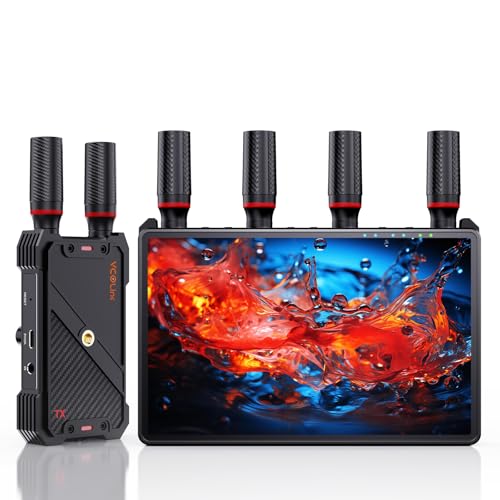
- Built-in 7-inch receiver monitor with HDMI output
- 1080p at 60Hz, below 0.05-second stated latency, and 1,312-foot LOS range
- One transmitter supports up to five receivers
Best For: Film crews, live events, studios, and shared production monitoring
Long-Range HDMI Convenience
Vrriis 1080p Wireless HDMI Kit

- 1080p/60Hz transmission with about 0.05-second latency
- Loop-out, dual receiver outputs, and IR support
- USB-C, adapter, and NP-F battery power options
Best For: 1080p streaming and multi-screen HDMI monitoring
Professional 4K Flexibility
Hollyland Pyro S Wireless System

- 4K30 transmission with HDMI and SDI connectivity
- Up to four receivers with app monitoring tools
- UVC and RTMP support for direct live streaming
Best For: Professional productions and multi-user live monitoring
Stream-Ready HDMI Transmitter

- 4K30 HDMI transmission with 60ms latency
- HDMI loop-out and support for up to four receivers
- UVC computer streaming and Hollyview app monitoring
Best For: Camera-based streaming with an existing Pyro receiver setup
Best Overall – Hollyland Pyro H
For shoppers comparing video transmitters for live streaming, the Hollyland Pyro H stands out with 4K30 transmission, dual-band connectivity, and USB Video Class support for direct computer streaming. Its HDMI loop-out and multi-receiver support also make it practical for production crews that need to monitor a camera feed from several locations.
Best For: Live streaming teams, filmmakers, and multi-person monitoring setups.
Pros:
- Supports up to 4K30 video transmission with 2.4 GHz and 5 GHz bands.
- Offers a claimed 1,300-foot range and approximately 60ms latency.
- UVC support enables plug-and-play streaming to a computer, while HDMI loop-out supports local monitoring.
- Smart Channel Scan helps select an available frequency automatically.
Cons:
- The kit includes one transmitter and one receiver, so additional receivers are needed for larger setups.
- Its feature set may be more than casual home users need.
The Pyro H is a strong all-around choice when range, crew monitoring, and direct computer streaming matter. It is especially well suited to dynamic productions where several viewers need access to the same camera feed.
Best for Simple Setup – TIMBOOTECH Wireless HDMI Extender
The TIMBOOTECH wireless HDMI kit is a straightforward option for buyers who want to send video and audio to a distant display without Wi-Fi, Bluetooth, or an app. While it is not as production-focused as some video transmitters for live streaming, its pre-paired design and 4K30 support can suit basic camera, presentation, and event-display applications.
Best For: Plug-and-play presentations, home theater, classrooms, and simple live-event display links.
Pros:
- Pre-paired transmitter and receiver provide a simple plug-and-play setup.
- Supports 720p, 1080p, and 4K30 video output.
- Uses 2.4 GHz and 5 GHz transmission with a stated line-of-sight range of up to 165 feet.
- One receiver can pair with up to eight transmitters, and the receiver supports Miracast, DLNA, and AirPlay mirroring.
Cons:
- The 165-foot range is shorter than the range offered by several creator-focused systems.
- Transmission performance can be affected by solid walls and other obstacles.
- The notes do not indicate dedicated UVC computer streaming support.
This TIMBOOTECH kit makes sense when ease of use and broad HDMI compatibility are more important than advanced production controls. For serious camera-to-OBS workflows, verify that its feature set matches your streaming setup before buying.
Best for Long-Range UVC Streaming – VRRIIS WL096 PRO 4K
The VRRIIS WL096 PRO is one of the more feature-rich video transmitters for live streaming in this group. It combines a stated 1,500-foot range with UVC output, 20 adjustable 5 GHz channels, loop-out monitoring, and support for sending one transmitter feed to as many as five receivers.
Best For: Long-range outdoor filming, multi-camera monitoring, and computer-based streaming through OBS or similar software.
Pros:
- UVC output connects to a computer over USB-C 3.0 without requiring a capture card, with output up to 1080p60.
- Supports 4K30 input-to-output video using H.265 encoding.
- Offers a stated 1,500-foot range and approximately 0.1-second latency.
- Provides 20 manually adjustable channels, LCD status displays, loop-out, and multiple power options.
Cons:
- Approximately 0.1-second latency is not recommended for applications requiring highly responsive real-time feedback, such as gaming.
- The included batteries are not listed among the supplied accessories.
- The extensive controls may be unnecessary for simple home setups.
With direct UVC output and unusually long stated range, the WL096 PRO is a compelling fit for streamers and production teams working over larger spaces. Its higher latency makes it better for broadcasting and monitoring than for interactive applications.
Best Low-Latency 1080p Option – Lemorele R5000 Wireless HDMI
The Lemorele R5000 is a practical choice for creators who prioritize smooth Full HD monitoring over 4K resolution. Among video transmitters for live streaming, it offers 1080p60 video, claimed 50ms latency, a 656-foot open-space range, HDMI loop-out, and flexible USB-C or NP-F battery power.
Best For: Filmmakers, live-event operators, classroom presenters, and mobile camera crews needing responsive 1080p monitoring.
Pros:
- Delivers 1080p at 60Hz with a stated 50ms low-latency connection.
- Provides a claimed 656-foot transmission range in open, unobstructed spaces.
- HDMI loop-out allows local viewing while transmitting wirelessly.
- Supports USB-C power and NP-F batteries, and includes TUTUPlay app preview for iOS and Android.
Cons:
- It is limited to Full HD rather than 4K transmission.
- The phone app is for preview only; phones cannot serve as the signal source.
- Only one transmitter and one receiver are included, despite support for up to four receivers.
The R5000 offers a balanced combination of low latency, useful range, and field-friendly power options. Choose it when reliable 1080p monitoring is more valuable than 4K resolution or direct UVC computer output.
Easy Home Streaming – AIMIBO 4K Wireless HDMI Kit
If you want video transmitters for live streaming without adding Wi-Fi, Bluetooth, or app setup, the AIMIBO kit is a straightforward choice. It supports up to 4K at 30Hz on the receiver, offers 1080p at 60Hz, and can transmit up to 165 feet in a barrier-free environment.
Best For: Home theaters, classrooms, meetings, gaming, and simple camera or laptop-to-display streaming setups.
Pros:
- Plug-and-play setup with no Wi-Fi, Bluetooth, or app required.
- Supports 4K at 30Hz and 1080p at 60Hz.
- Can pair up to eight transmitters with one receiver for content sharing.
- Includes mini and micro HDMI adapters for broader device compatibility.
Cons:
- The advertised 165-foot range applies to barrier-free conditions; walls or floors can reduce it to about 32 feet.
- Its 4K support is limited to 30Hz on the receiver.
- Streaming performance can be affected by interference and obstructions.
The AIMIBO is a practical pick when simple installation and flexible HDMI compatibility matter more than professional production features. Its multi-transmitter support is useful for meetings and shared displays, while the 0.1-second latency suits general viewing and presentations.
Professional Production – Hollyland Mars 4K Wireless System
For production teams comparing video transmitters for live streaming, the Hollyland Mars 4K stands out with HDMI and SDI connectivity, 4K video support, and monitoring options for both displays and mobile devices. It reaches up to 450 feet line of sight in laboratory conditions, with stated latency of 66 milliseconds.
Best For: Film sets, live production, camera crews, directors, and users who need SDI compatibility alongside HDMI.
Pros:
- Handles video up to 3840×2160 at 24, 25, or 30 frames per second through HDMI.
- Provides HDMI and 3G-SDI input/output for professional production equipment.
- Supports up to four app monitoring options, plus wired display monitoring with a receiver.
- Offers multiple power options, including DC power, NP-F batteries, and USB-C power.
Cons:
- The 450-foot range is specified for interference-free laboratory line-of-sight conditions.
- Latency is higher than some ultra-low-latency systems at a stated 66 milliseconds.
- QC/PD protocol and 5V/2A charging are not supported.
The Mars 4K is the more production-focused option in this group. Its SDI support, decimal-point frame-rate handling, LCD status screen, and app monitoring make it better suited to coordinated shoots than basic home HDMI mirroring.
Long-Range Crew Monitoring – 7-Inch Wireless HDMI System
This system is designed for teams that need video transmitters for live streaming with built-in monitoring and long-distance coverage. It sends 1080p at 60Hz up to a stated 1,312 feet line of sight, includes a 7-inch receiver display, and supports one transmitter broadcasting to as many as five receivers.
Best For: Film crews, live events, studios, and multi-viewer setups where local and client monitoring are important.
Pros:
- Built-in 7-inch receiver monitor reduces the need for an extra display.
- Supports 1080p at 60Hz with stated latency below 0.05 seconds.
- One transmitter can send to up to five receivers for collaborative viewing.
- Includes HDMI loop-out, IR remote control, and flexible NP-F, power-bank, or USB-C power options.
Cons:
- The 1,312-foot range is specified for line-of-sight use.
- An HDMI cable for connecting the receiver to an external monitor is not included.
- Smartphone and tablet use requires a Type-C-to-HDMI cable.
The built-in screen and five-receiver capability make this a strong choice for on-set collaboration. It is especially useful when camera operators, clients, and producers need simultaneous views without assembling separate monitoring hardware.
Long-Range HDMI Convenience – Vrriis 1080p Wireless HDMI Kit
For buyers comparing video transmitters for live streaming, this Vrriis kit emphasizes straightforward 1080p wireless HDMI transmission, flexible power options, and convenient monitoring features. It can send a signal up to 1,300 feet in an open field, although walls and other obstructions may reduce coverage.
Best For: Home studios, event setups, gaming, sports viewing, and users who need wireless HDMI with local and remote monitoring.
Pros:
- Supports 1080p at 60Hz with approximately 0.05-second latency.
- Includes transmitter loop-out and dual HDMI outputs on the receiver for multi-screen monitoring.
- Offers USB-C, adapters, and NP-F battery compatibility for flexible powering.
- Can connect one transmitter to up to five receivers, with reduced range as receivers are added.
Cons:
- Transmission distance can drop significantly through walls, brick, metal, or glass.
- Batteries are not included.
- Limited to Full HD rather than 4K transmission.
This is a practical choice when reliable 1080p HDMI distribution matters more than 4K quality. Its loop-out, IR support, and multiple power choices make it adaptable, but the advertised range is most realistic in open, interference-free conditions.
Professional 4K Flexibility – Hollyland Pyro S Wireless System
The Hollyland Pyro S is a versatile option among video transmitters for live streaming, combining HDMI and SDI connectivity with 4K30 transmission, UVC computer streaming, and RTMP support. Its automatic dual-band hopping is designed to help maintain a stable connection in changing wireless environments.
Best For: Professional live streams, film production, ENG/EFP work, and teams that need multi-receiver monitoring.
Pros:
- Supports up to 4K at 30 frames per second and 1080p at 60 frames per second.
- Provides both HDMI and SDI input/output connections for broad equipment compatibility.
- Transmits up to 1,300 feet with claimed latency of 50ms in suitable conditions.
- Supports up to four receivers, UVC computer streaming, RTMP, and monitoring tools through the app.
Cons:
- The listed package is a 1TX+1RX configuration, so additional receivers may require separate purchases.
- Its professional HDMI/SDI feature set may be more than basic streamers need.
- Wireless range and stability can vary with the shooting environment.
Pyro S is the strongest fit here for production teams that need format flexibility and direct streaming options. HDMI and SDI support, app-based monitoring, and multi-receiver operation make it suitable for more demanding workflows than a basic wireless HDMI extender.
Stream-Ready HDMI Transmitter – Hollyland Pyro H TX
For streamlined video transmitters for live streaming setups, the Hollyland Pyro H TX focuses on wireless HDMI transmission from a camera to receivers, monitors, or a computer. It supports 4K30 input/output formats, UVC streaming, HDMI loop-out, and dual-band operation in a transmitter-only package.
Best For: Camera operators, live broadcasters, and small production teams that already have compatible receivers or need a dedicated camera transmitter.
Pros:
- Supports HDMI video up to 3840×2160 at 24, 25, or 30fps.
- Offers up to 1,300 feet of transmission range and 60ms latency under suitable conditions.
- Includes HDMI input, output, and loop-out for camera and monitor connections.
- Supports up to four receivers, Hollyview app monitoring, and UVC plug-and-play computer streaming.
Cons:
- This listing includes the transmitter only, not a complete transmitter-receiver kit.
- It is HDMI-only and does not provide the SDI connectivity offered by the Pyro S.
- Actual wireless range depends on interference and the surrounding environment.
Pyro H TX makes sense when you want to add a transmitter to an existing Pyro setup or stream directly to a computer over UVC. Its loop-out and receiver-sharing capabilities are useful for production monitoring, but buyers should account for the separate receiver requirement.
How We Picked These Video Transmitters for Live Streaming
We selected systems across several live-production needs, including camera-to-switcher links, remote monitoring, event coverage, studio streaming, and multi-display setups. We compared stated resolution, wireless range, latency, HDMI and SDI compatibility, receiver capacity, loop-out options, USB connectivity, frame-rate support, and setup flexibility.
Because advertised range depends on interference, walls, antenna placement, and line of sight, treat maximum-distance figures as best-case estimates rather than guaranteed indoor performance. A dependable connection at a shorter practical distance is often more valuable than an impressive headline range.
Quick Comparison
| What to Compare | Best Fit |
|---|---|
| 1080p HDMI systems | Budget streaming, basic monitoring, and uncomplicated camera links |
| 4K HDMI systems | Creators who want high-resolution capture or future-ready production |
| HDMI and SDI support | Professional cameras, switchers, and mixed production environments |
| Multiple receiver support | Productions requiring several monitors, operators, or destinations |
| USB or UVC output | Direct connection to a computer or streaming software |
| Loop-out | Sending video to another device while monitoring locally |
Key Buying Factors for Video Transmitters for Live Streaming
Resolution and Frame Rates
Match the transmitter to the source camera and the rest of your production chain. A 4K transmitter is useful when you record or monitor in 4K, but a 1080p workflow may benefit more from lower cost and simpler compatibility. Check supported frame rates, especially for 23.98, 29.97, 59.94, and 60fps production.
Latency and Reliability
Low latency matters when presenters, camera operators, and directors must react to live action. Look beyond the quoted delay and consider signal stability, interference resistance, line-of-sight requirements, and whether the system can maintain a usable connection in your venue.
Inputs, Outputs, and Compatibility
Confirm whether you need HDMI, SDI, or both. SDI is often preferable for professional cameras and longer wired runs, while HDMI is common on mirrorless cameras and consumer equipment. Loop-out, UVC output, and audio handling can determine whether the transmitter fits your existing switcher or computer-based setup.
Range, Receivers, and Power
Choose enough range for your actual venue, allowing room for obstructions and repositioning. Multi-receiver support is valuable for director monitors, confidence displays, and remote operators. Also check battery life, USB-C or DC power options, mounting hardware, and whether transmitters and receivers can be powered continuously.
Who Should Buy Which Video Transmitters for Live Streaming?
Casual streamers and beginners: A straightforward 1080p HDMI kit is usually the most economical choice for a single camera and nearby receiver.
Mobile creators and event teams: Choose a compact 4K HDMI system with dependable range, low latency, and flexible power options when you move between locations.
Professional video crews: A system supporting both SDI and HDMI is the safer long-term choice for mixed cameras, switchers, and studio equipment.
Multi-monitor productions: Prioritize models supporting several receivers or monitors, especially when the director, talent, and technical crew need separate views.
Computer-based streamers: Look for UVC output or a compatible capture workflow so the wireless feed can reach OBS, vMix, or other streaming software without unnecessary adapters.