Reliable video distribution can make a major difference in church services, overflow rooms, classrooms, and online broadcasts. The right wireless receiver helps move a camera, presentation feed, or production output without adding long HDMI runs across the building.
This roundup compares 10 wireless video systems by range, receiver capacity, latency, output options, and streaming compatibility. Use the buying guide below to match the equipment to your sanctuary layout and production workflow.
Best 10 Wireless Video Receivers for Church Streaming Picks for 2026
Best Long-Range Pick

- Up to 820-foot claimed range
- 1080p at 60Hz with under 0.06s latency
- Supports one transmitter to four receivers
Best For: Large sanctuaries and multi-screen church setups
Best Multi-Screen Value
YUYUNLOMN G58 Wireless HDMI Kit

- Includes four receivers
- Supports up to six receivers
- Pre-paired 1080p/60fps operation
Best For: Multi-room church displays and overflow screens
Best for Computer Streaming
- UVC output works with OBS workflows
- 20 manually selectable channels
- Up to five receivers supported
Best For: Church production teams streaming to a computer
Best Simple Dual-Display Kit

- Includes two receivers
- Pre-paired plug-and-play setup
- 1080p at 60Hz over dual-band wireless
Best For: Two nearby sanctuary or overflow displays
Best All-in-One Monitor
- Built-in 7-inch receiver monitor
- Supports up to five receivers
- 1080p60 with long-range transmission
Best For: Church teams needing portable monitoring and multiple receiver outputs
Best for Everyday Use
Dual-Receiver Wireless HDMI Kit

- Includes two synchronized receivers
- Expandable to up to eight receivers
- Includes multiple HDMI adapters
Best For: Multi-room church displays within a moderate range
Best for Professional Streaming
Accsoon CineView HE Wireless Video System

- UVC livestreaming without a capture card
- Supports up to four monitoring devices
- 1,200-foot range and HDMI loop-out
Best For: Experienced church production teams using OBS or RTMP streaming
Flexible Presentation Pick
Multi-Device Wireless HDMI Kit

- 1080p/60Hz wireless video and audio
- Adapters support many source devices
- Receiver can pair with up to eight transmitters
Best For: Portable church presentations and overflow displays
Live Production Pick
Pocket 3 Wireless Video System

- HDMI and UVC outputs for streaming workflows
- 1080p/60fps with claimed 0.05-second latency
- LCD and 20 channels help manage interference
Best For: Pocket 3, camera, and OBS-based church production
Long-Range Value Pick

- 1080p/60Hz output with duplicate and extended modes
- Claims up to 328 feet outdoors
- Plug-and-play dual-band transmission
Best For: Cable-free church displays and presentations
Best Long-Range Pick – BovBox WL-900S
For churches needing wireless video receivers for church streaming across a large campus or sanctuary, the BovBox WL-900S stands out for its claimed long range, low latency, and multi-receiver support. It outputs 1080p at 60Hz and includes a transmitter loop-out for local monitoring.
Best For: Large worship spaces, overflow rooms, and teams that need one camera feed on multiple displays.
Pros:
- Claimed range of up to 820 feet with one receiver; up to four receivers supported.
- 1080p at 60Hz output with less than 0.06-second latency.
- Loop-out supports local monitoring or recording.
- Supports NP-F batteries and USB-C power banks for extended events.
Cons:
- Multi-receiver range is listed as approximately 623 feet.
- Requires separate power for the transmitter and receiver units.
The WL-900S is a strong fit when distance and simultaneous screen distribution matter most. Its 1080p output and loop-out also suit church production teams that need to monitor the source locally while sending video wirelessly.
Best Multi-Screen Value – YUYUNLOMN G58 Wireless HDMI Kit
The YUYUNLOMN G58 is designed for wireless video receivers for church streaming when one source must feed several TVs or monitors. Its included four receivers are pre-paired, while the system can support up to six receivers with additional units.
Best For: Churches distributing presentations, services, or announcements to several screens and rooms.
Pros:
- Includes one transmitter and four receivers for multi-screen expansion.
- Supports up to six receivers with added units.
- Pre-paired plug-and-play setup requires no Wi-Fi, Bluetooth, or drivers.
- Outputs 1080p at 60fps and includes USB-C, Mini HDMI, and Micro HDMI adapters.
Cons:
- Listed range drops from up to 165 feet to approximately 50 feet when all four receivers are connected.
- Walls and other obstacles can reduce transmission distance.
This kit is practical for multi-room church distribution, especially when simple setup matters more than maximum range. Plan receiver placement carefully, since the stated distance is substantially shorter when all four receivers operate together.
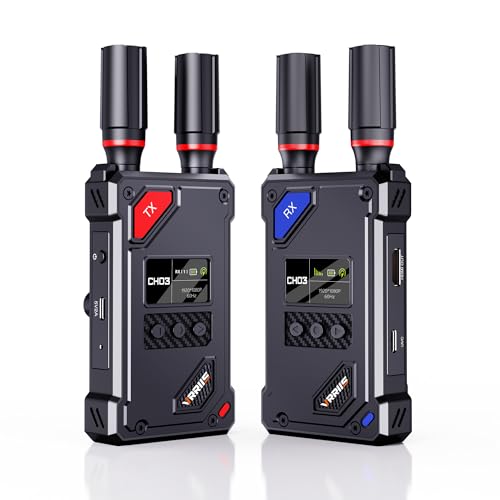
Best for Computer Streaming – Vrriis WL087
For churches using OBS or another computer-based workflow, the Vrriis WL087 adds UVC output so received video can reach a streaming computer through USB-C without a separate capture device. It also offers manual channel selection and a transmitter loop-out.
Best For: Live-stream teams that want to send a wireless camera feed directly into a computer-based production system.
Pros:
- UVC output supports streaming to platforms such as OBS without an additional capture device.
- 20 selectable channels help manage interference.
- Claims up to 1,500 feet of line-of-sight range and 0.05-second latency in open conditions.
- Supports up to five receivers and includes HDMI loop-out for local monitoring.
Cons:
- Walls, metal, brick, and glass can significantly reduce range.
- Batteries are not included.
- Additional receivers can reduce transmission distance.
The WL087 is the most streaming-oriented option in this group because of its built-in UVC output. Its channel display and manual tuning are useful in busy venues, but the impressive range claim depends on clear line-of-sight conditions.
Best Simple Dual-Display Kit – YAOMAISI G9R Pro
The YAOMAISI G9R Pro is a straightforward choice among wireless video receivers for church streaming when the goal is to send one HDMI source to two displays. The included transmitter and two receivers arrive pre-paired and support 1080p at 60Hz.
Best For: Churches connecting a laptop, presentation computer, or HDMI source to two nearby TVs or monitors.
Pros:
- Includes one transmitter and two receivers for simultaneous two-screen output.
- Pre-paired setup requires no apps, drivers, Wi-Fi, or Bluetooth.
- Supports 1080p at 60Hz with dual-band 2.4GHz/5GHz operation.
- Included USB-C-to-HDMI adapter helps connect newer laptops.
Cons:
- Open-area range is up to 165 feet, but the stated wall or ceiling range is about 50 feet.
- The transmitter must connect to an HDMI output device, not directly to a TV.
- Additional receivers are sold separately.
The G9R Pro is best suited to modest-distance, two-display installations where ease of setup is more important than advanced production features. Confirm that the source device has HDMI output and use a stable 5V/1A power supply for dependable operation.
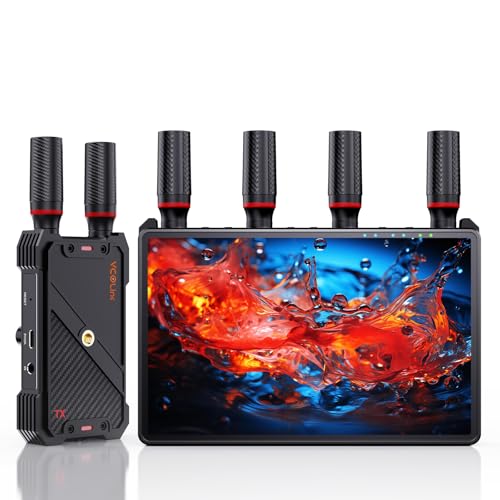
Best All-in-One Monitor – 7-Inch Wireless HDMI System
For churches looking for wireless video receivers for church streaming, this system combines a receiver, built-in 7-inch monitor, and HDMI output in one portable package. It supports 1080p at 60Hz, offers up to 1,312 feet of line-of-sight range, and is designed for low-latency monitoring during live production.
Best For: Church streaming teams that need on-camera monitoring, local HDMI output, and support for multiple viewing locations.
Pros:
- Built-in 7-inch display reduces the need for a separate monitor.
- One transmitter can connect with up to five receivers.
- HDMI loop-out, IR remote control, and headphone monitoring add production flexibility.
- Supports NP-F battery, power bank, and USB-C power options.
Cons:
- The listed long-range performance is specified for line-of-sight use.
- An HDMI cable is not included for connecting the receiver to an external display.
- A Type-C-to-HDMI cable is required for smartphone or tablet compatibility.
Its built-in screen makes this a practical choice for volunteer crews and mobile church setups. The five-receiver capacity is useful when camera operators, directors, or other production staff need separate monitoring feeds.
Best for Everyday Use – Dual-Receiver Wireless HDMI Kit
This kit is a flexible option for churches comparing wireless video receivers for church streaming across two displays. It includes two receivers, supports up to eight receivers with additional units, and delivers synchronized 1080p at 60fps over a stated range of up to 165 feet.
Best For: Churches that need synchronized video on multiple TVs or monitors in classrooms, overflow areas, or meeting spaces.
Pros:
- Includes two receivers and can expand to as many as eight with additional units.
- Pre-paired plug-and-play operation requires no Wi-Fi, Bluetooth, app, or drivers for standard use.
- LED diagnostic displays show signal strength, connection status, and power information.
- Includes USB-C-to-HDMI, Micro HDMI, and Mini HDMI adapters.
Cons:
- The 165-foot range can decrease through walls or other obstacles.
- With eight receivers connected, the stated range drops to approximately 50 feet.
- It is not intended for TV-to-TV transmission and is not compatible with satellite receivers such as Dish Wally.
The included adapters and straightforward setup make this a convenient choice for churches with varied source devices. Its shorter stated range is better suited to rooms and buildings where displays are relatively close to the transmitter.
Best for Professional Streaming – Accsoon CineView HE Wireless Video System
For production teams that need wireless video receivers for church streaming with computer-based workflows, the Accsoon CineView HE adds UVC livestreaming and RTMP support to a professional wireless video system. It transmits 1080p at 60fps, offers a stated 1,200-foot range, and supports monitoring on up to four devices.
Best For: Larger church productions using OBS or other computer-based streaming workflows, multiple monitors, and experienced camera crews.
Pros:
- UVC support enables plug-and-play computer livestreaming without a capture card.
- RTMP capability supports direct streaming to platforms such as YouTube Live and TikTok Live.
- Dual-band transmission, HDMI loop-out, and sub-0.06-second latency support live production.
- Can send video to up to four receivers or compatible iOS and Android devices.
Cons:
- The package does not include batteries or charging cables.
- It is a more feature-rich system than smaller church setups may require.
- RTMP streaming requires connecting to a network through a wireless card.
The CineView HE stands out when streaming is handled from a computer and the production team needs app monitoring or direct RTMP capability. Its multiple power options and HDMI loop-out also suit longer services and more involved camera operations.
Flexible Presentation Pick – Multi-Device Wireless HDMI Kit
For buyers comparing wireless video receivers for church streaming, this kit is a flexible option for sending content from laptops, cameras, phones, and other HDMI sources to a projector, monitor, or TV. It supports up to 1080p at 60Hz, includes several adapters, and can pair with up to eight transmitters for switching between devices.
Best For: Churches needing a portable presentation and overflow-display setup with broad device compatibility.
Pros:
- Supports 1080p at 60Hz and 3D video.
- Works with laptops, cameras, smartphones, set-top boxes, projectors, and monitors.
- Plug-and-play design requires no driver or app.
- One receiver can match up to eight transmitters.
Cons:
- The listed 165-foot range can drop substantially through thick cement walls or between floors.
- The package does not include a 5V/2A charger.
- The system’s stated video support is up to 1080p, despite the 4K-oriented product title.
This is a practical choice when church volunteers need to switch among multiple source devices without running long HDMI cables. Its adapter bundle adds convenience, while the receiver’s multi-transmitter capacity can help in flexible meeting or presentation environments.
Live Production Pick – Pocket 3 Wireless Video System
For church streaming teams using a DJI Osmo Pocket 3 or other HDMI sources, this system combines wireless transmission with HDMI and UVC outputs. It delivers 1080p at 60fps with claimed 0.05-second latency, plus channel controls and multiple power options suited to live production.
Best For: Churches and event teams building a low-latency Pocket 3, camera, or OBS-based streaming workflow.
Pros:
- Provides HDMI and UVC outputs for computers, projectors, switchers, and OBS workflows.
- Supports 1080p at 60fps with claimed 0.05-second latency.
- Offers up to 1,640 feet of line-of-sight range under stated conditions.
- Includes 20 selectable 5GHz channels and an LCD for monitoring signal conditions.
Cons:
- The Pocket 3 connection is designed for horizontal video, not vertical video.
- Walls, brick, metal, and glass can reduce range or cause signal loss.
- The feature set is more specialized than necessary for basic projector presentation.
Among these wireless video receivers for church streaming, this is the most production-focused option. HDMI loop-out, UVC support, channel selection, and reverse charging make it well suited to mobile camera positions and computer-based streaming, provided the venue’s layout supports a reliable line-of-sight link.
Long-Range Value Pick – 100m Wireless HDMI Extender
This wireless HDMI extender is a straightforward option for church streaming, presentations, and overflow displays when you want to avoid long HDMI runs. It outputs 1080p at 60Hz, uses dual-band wireless transmission, and claims up to 328 feet outdoors or 165 feet indoors.
Best For: Churches seeking an easy, cable-free link between a source device and a remote display.
Pros:
- Plug-and-play setup requires no Wi-Fi, app, or Bluetooth.
- Supports 1080p at 60Hz with extended and duplicate display modes.
- Uses 2.4GHz and 5.8GHz bands for signal transmission.
- Compact 0.3-pound design includes micro HDMI and mini HDMI adapters.
Cons:
- Both the transmitter and receiver must be connected to power.
- Walls and other obstacles can reduce the stated transmission distance and speed.
- The supplied notes specify 1080p output rather than 4K output.
This model emphasizes simple installation and useful range rather than advanced production controls. It can fit a church’s presentation, classroom, or overflow-display setup well, especially when the source and receiving screen are separated by an open path.
How We Picked the Best Wireless Video Receivers for Church Streaming
We focused on systems suited to real church production needs: dependable HDMI transmission, practical range, low delay, support for multiple receivers, and compatibility with displays, switchers, monitors, or streaming computers. We also considered features such as UVC output, loop-through HDMI, IR control, dual-band operation, channel selection, and included receiver counts.
Specifications can vary by walls, interference, line of sight, resolution, and the source device. Treat advertised range as a best-case figure and verify that the kit supports your exact camera, laptop, switcher, or encoder before purchasing.
Quick Comparison
- Best for multiple displays: Choose a transmitter that supports several receivers or expandable receiver pairing.
- Best for livestream production: Look for UVC output, HDMI output, low latency, and compatibility with OBS or similar software.
- Best for long venues: Prioritize stable range, external antennas, and clear channel controls rather than resolution alone.
- Best for simple presentation systems: Plug-and-play HDMI kits can connect a source to one or more TVs with minimal setup.
- Best for camera monitoring: A low-latency system with 1080p at 60Hz is generally more useful than a higher-resolution kit with noticeable delay.
Key Buying Factors for Wireless Video Receivers for Church Streaming
Range and Building Layout
Measure the real path between the transmitter and receiver, including walls, ceilings, and equipment racks. A sanctuary may require more range than a small fellowship hall, while reinforced concrete and crowded wireless environments can reduce performance.
Latency and Motion Handling
Latency matters when camera operators, musicians, presenters, and on-screen video must stay synchronized. For live services, prioritize systems advertising low delay and test them with your camera and switcher before deploying them permanently.
Outputs and Streaming Compatibility
HDMI output is useful for TVs, projectors, confidence monitors, and switchers. UVC output is especially valuable when the receiver needs to appear as a camera source to a computer running OBS or another streaming platform. Confirm whether the system supports the desired resolution and frame rate at the same time.
Multi-Receiver Capacity
Church installations often feed several destinations: sanctuary displays, lobby screens, classrooms, and recording or streaming systems. A kit that supports multiple receivers can simplify expansion, but check whether additional receivers are included or sold separately.
Reliability and Operation
Manual channel selection, dual-band wireless operation, signal indicators, loop-out, remote control, and a wired fallback can make weekly setup and troubleshooting easier. Avoid placing transmitters inside enclosed metal cabinets or directly beside other high-powered wireless equipment.
Who Should Buy Which Wireless Video Receivers for Church Streaming?
Choose a multi-receiver HDMI kit if your primary goal is distributing one presentation or camera feed to several TVs or projectors. Choose a UVC-capable system if the receiver will connect directly to a streaming computer or OBS workflow. Choose a low-latency 1080p system for live camera monitoring, stage confidence displays, or IMAG-style use. Choose a longer-range model when the transmitter and receiver must cross a large sanctuary or several rooms, but confirm performance in the actual building. Choose a 4K-capable kit only when your source, displays, and production hardware all benefit from 4K; otherwise, stable 1080p transmission may deliver better value and compatibility.